Showing posts with label canada. Show all posts

Thursday, January 8, 2009

SkyHook International making progress but strugeling with the financial crisis

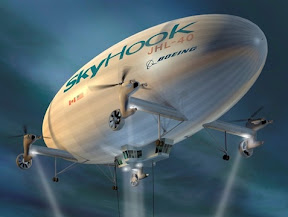
The JHL-40 designed by the Canadian Company SkyHook International and built by Boeing is making the news these days. The Calgary Sun has an article titled "Hybrid blimp plans face financial hurdle" the article gives a quick introduction on Skyhook and then talks about the current progress:
Within the next few months, SkyHook and Boeing expect to release further details of the aircraft, dubbed the JHL-40, Jess said, adding that by mid-summer 2009, all systems that go into building the aircraft -- there are about 2,500 of them -- will be selected.
and the financial situation which has become more difficult but not impossible
Shaky financial markets and lenders that have grown more reluctant to finance projects, however, have also made it more difficult for SkyHook to raise the financing needed for the first JHL-40 to be built by late 2012 or early 2013.

"It's progressing. It's just not as easy as it was a year ago," Jess said about the search for financial backers, noting he has received several commitments for funding.
You can read the full article at the Calgary Sun canoe.ca website.
While researching todays post I also found another very interesting article about the Boeing JHL-40 SkyHook in the Shipping Digests Air Cargo Category called "BOEING’S BLIMP" also featuring an Interview with Barry Prentice known from the Airships to the Arctic Symposium that he organizes with his research institute ISO Polar. The article is really worth a read as it goes into great detail what the JHL-40 is how and where it will be built and why it is of great use for the northers regions of Canada.
Also check out our older posts about the SkyHook concept.

Links:
I want to thank Darrell Campbell from TURTLE AIRSHIPS for the tip on the Calgary Sun article.

Wednesday, July 9, 2008

Boeing/Skyhook International JHL-40 heavy lift rotorcraft

As nice as it is to write about the Zeppelin and other airship operations it is always nice to be able to report about something refreshingly new. Boeing and the Canadian Company Skyhook International supirsed yesterday with a press release that they are going to develop a heavy lift rotor craft. The concept called JHL-40 (Jess Heavy Lifter) named after the SkyHook president and COO Pete Jess. The 40 stands for a 40-ton (88 000 lb) lifting capability. The airship will have an envelope that will make it neutrally buoyant and 4 rotors that will be used to lift the cargo. Here is the full press release:
ST. LOUIS, July 08, 2008 -- The Boeing Company [NYSE: BA] and SkyHook International Inc. today announced a teaming agreement to develop the JHL-40 (Jess Heavy Lifter), a new commercial heavy-lift rotorcraft designed to address the limitations and expense of transporting equipment and materials in remote regions. Boeing has received the first increment of a multiyear contract from SkyHook to develop the new aircraft.

"SkyHook secured the patent for this neutrally buoyant aircraft and approached Boeing with the opportunity to develop and build the system," said Pat Donnelly, director of Advanced Rotorcraft Systems for Boeing. "We conducted a feasibility study and decided this opportunity is a perfect fit for Advanced Systems' technical capabilities."

The neutrally buoyant feature allows SkyHook to safely carry payloads unmatched by any rotorcraft in existence today. The helium-filled envelope is sized to support the weight of the vehicle and fuel without payload. With the empty weight of the aircraft supported by the envelope, the lift generated by four rotors is dedicated solely to lifting the payload, leaving the aircraft neutrally buoyant.

The SkyHook JHL-40 aircraft will be capable of lifting a 40-ton sling load and transporting it up to 200 miles without refueling in harsh environments such as the Canadian Arctic and Alaska. Currently, conventional land and water transportation methods in these undeveloped regions are inadequate, unreliable and costly. With its lifting capacity and range, the SkyHook JHL-40 aircraft changes that for a variety of industries around the world.

"There is a definite need for this technology. The list of customers waiting for SkyHook's services is extensive, and they enthusiastically support the development of the JHL-40," said Pete Jess, SkyHook president and chief operating officer. "Companies have suggested this new technology will enable them to modify their current operational strategy and begin working much sooner on projects that were thought to be 15 to 20 years away. This Boeing-SkyHook technology represents an environmentally acceptable solution for these companies' heavy-lift short-haul challenges, and it's the only way many projects will be able to progress economically."

The JHL-40 is environmentally acceptable because it mitigates the impact of building new roadways in remote areas, and Skyhook is expected to reduce the carbon footprint of the industrial projects it supports.

Boeing is designing and will fabricate two production prototypes of the JHL-40 at its Rotorcraft Systems facility in Ridley Park, Pa. Skyhook will own, maintain, operate and service all JHL-40 aircraft for customers worldwide. The new aircraft will enter commercial service as soon as it is certified by Transport Canada and the U.S. Federal Aviation Administration.

SkyHook International Inc. is a privately owned company located in Calgary, Alberta, Canada. SkyHook principals have been focused on providing solutions to logistical challenges in remote regions. They have a 30-year history in remote area operations and logistics in support of exploration, research and development in isolated regions of the world. For more information, visit www.skyhookinternational.com.
A unit of The Boeing Company, Boeing Integrated Defense Systems is one of the world's largest space and defense businesses specializing in innovative and capabilities-driven customer solutions. Headquartered in St. Louis, Boeing Integrated Defense Systems is a $32.1 billion business with 71,000 employees worldwide.
Everyone with just a little experience in airships will be reminded of the Piasecki PA-97 Helistat which looks quite similar to the new JHL-40 project. This is also what the National Post pointed out in their article about this new aircraft. Unfortunately Piaseckis Helistat built in the 1980s under a US Navy contract was probably to early for it's time having 4 real Helicopter attached to an old Navy blimp envelope that was of no use anymore. The helicopters were controlled by a single pilot sitting in one of the helicopters controlling the others through a cable system. Check out the Wikipedia article on the Piasecki PA-97 Helistat the article also links to a video that shows some footage of the final catastrophic flight. Pessimists would proably argue because it didn't work back then it wont work today. But one has to realize the differences. The PA-97 was pieced together out of old pieces that were reused. It wasn't an aircraft designed from the ground up, without any electronic stabilization or computer assistance. Now over 20 years later the game has changed and if Boeing and Skyhook are developing this craft from the ground up I have no doubt that they will be successful. You should also check out the Skyhook International Website which has lots of pictures and additional information. I assume that the site will grow with time.

But let's have a closer look at the press release and read between the lines. The unit at Boeing that will work on this is the Integrated Defense Systems and in there the Rotorcraft Systems department. Looking at the aircrafts available one of them sticks out. The V-22 Osprey a tilt rotor aircraft that is quite unique in the world. Also read the Wikipedia article on the Osprey. Now why look at the Osprey and not at the Chinook? The Osprey can carry up to 15,000 lbs (6,147 kg) where as the Chinook can carry 26,000 lbs (11,794 kg). Well we now have to look for another clue in the press release. The acronym JHL-40. Sure the press release talks about "Jess heavy Lift" but is this really the whole truth? While reading an article about the Skyhook on gizmag.com I stumbled across this article that talks about a Quad TiltRotor (QTR) aircraft for the Joint Heavy Lift Programm of the US Army and there they are again our three letters JHL (Joint Heavy Lift) or (Jess Heavy Lift). According to Global Security.org
The Joint Vertical Aircraft Task Force is developing requirements to meet Army and Navy needs for a heavy lift transport rotorcraft that is expected to include, at a minimum, a 20-ton payload lift capability. The Army hasn’t settled on what kind of aircraft it envisions: it could be a quad tiltrotor, conventional helicopter, or a hybrid.
The last word in this introduction is key "hybrid". So an airship, quad tiltrotor hybrid ? It's possible. If you look at the first info of a QTR(quad tilt rotor) from Being it's probably this pressrelease where Boeing IDS is awarded the contract the QTR as part of the JHL program. And now we come full circle back to the Osprey since the QTR is a evolution pretty much using the technology of the Osprey. So 4 instead of 2 rotors let's say that doubles the lift then we get from 2 x 6,147 kg = 12294 kg or 12 tons or if we size it up and use the Chinook figures 2 x 11,794 kg = 23,588 or 23 tons which is above the limit of the 20-ton payload lift capability mentioned in the JHL program. But all these numbers are when using conventional technology. An Osprey actually has maximum vertical takeoff weight of 23,859 kg = 23 tons make it 4 rotors (2 Ospreys) and you have 40 tons. If you want to have those 40 tons as useful payload all you need to do is to neutralize the empty takeoff weight of the "2 Ospreys" which is roughly 20 tons. Considering the Zeppelin NT 07 has enough Helium to produce a raw lift of 7 tons without it's structure an airship envelope a bit bigger than twice the size should do it. So there you have it that's how you get to the JHL-40 it's all possible you just have to do the math. Of course this was really naive math and I am happy to get input from the professionals in the industry if they could chime in in the Forum or the comments on the Blog I am sure I have made mistakes or made incorrect assumptions or is it all sound. Send me your feedback positive as well as negative.

Thanks to hildy from the luftschiff_abt who pointed this story out first. Also thanks to Dan Nachbar for the thought on the Osprey and lvlta_designer from the Yahoo AirshipList for pointing me to the gizmag.com article that led me to the JHL stuff.

Tuesday, May 20, 2008

An Airship for Disaster Relief - Solarial

There have been many ideas on how to use airships, may it be as mobile camera platforms either remote controlled or manned, for sightseeing flights, as high altitude platform, as aerial cruise ships or business yachts or even as surveillance tool. Using Airships in disaster relief has not been discussed for a while but the recent disasters in China and Burma which almost coincidentally happened right around the time when the 2008 ACIDO Rocket Show and competition announced their winners changed this. The ACIDO Rocket 2008 is a graduation show and competition where students of the three schools of Industrial Design in Ontario Canada present their works. One of the Categories was Natrual Disaster and Andrew Leinonen from the Humber College with his concept called "Solarial – Mobile Power Generation for Disaster Relief" won best in category. This is how he describes his project:
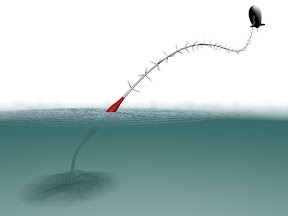
Solarial is an unmanned airship that provides mobile support infrastructure for disaster relief and remote communities, generating renewable energy and supplying communications links where they are needed most. Utilizing a skin coated in thin film photovoltaics, and a reversible drive propeller/wind turbine, it delivers clean energy via tether cable. Housing a suite of telecommunications equipment, Solarial also acts as a relay station for radio and cellular telephone signals, aiding the coordination of relief operations.

While that's the mission brief for the project, the rationale behind it was to produce an airship at a modest scale, fulfilling a present need, to act as a transitionary element towards a more sustainable aerospace industry based around airships.
You can check out the presentation on the ACIDO Website which features some very nice pictures and illustrations on how the concept is supposed to work. Even more information can be found on Andrews Blog pulltheskydown.com where he talks about the Solarial Concept in more detail. What's most interesting about the Solarial concept is that it combines multiple ideas into one package. Having a quickly deployed airship that turns into a tethered aerostat that can provide energy as well as a telecommunications relay for on site communications gives new flexibility to disaster relief. The Solarial is also supposed to fly autonomously to it's destination giving humanitarian help organization a chance to call for a Solarial which will then provide the necessary base infrastructure on a disaster site. In the coming years we will hopefully see more airships being used in disaster relief especially if more people demand them, because they can be a solution to today's problems in building up infrastructure at disaster sites.

But building up infrastructure is not only a topic that is interesting for humanitarian missions the military is also very interested in using airships for their missions. Using small airships for surveillance or larger ones as communication platforms. While writing this article I remembered a project by BOSCH Aerospace called
REAP (Rapid Elevated Aerostat Platform) which is a project where an Aerostat is being transported deflated by jeep to the site, and then inflated and deployed in a matter of minutes. Check out this YouTube video of the REAP System:

REAP Rapid Elevated Aerostat Platform

While the REAP Platform is mostly used for surveillance the way it is deployed is quite remarkable seeing the aerostat inflating completely by itself without any human interaction.
Another project that came to my mind is the Selsam SUPERTURBINE a project to create highly efficient wind power generators. One of the concepts also includes a blimp that is tethered and has Superturbines attached to the tether. Something that could be incorporated with the Solarial? Or what about the Magenn Windtrubine also a lighter-than-air tethered power generator. The Magenn project just recently made the first trial test with their system, we reported on it here.

The possibilities seem to be endless when it comes to envisioning the usages of airships for green power generation. We are looking forward to the future hoping to the these projects become reality.

If you know of other projects that are using airships in new and exciting ways let us know. Also I want to thank Duncan Rice, Paul Bloch and Andrew Leinonen for their input which helped me write this article.

Wednesday, May 7, 2008

The Magenn Wind Turbine gets of the ground.

Early last year we talked about the The Magenn Air Rotor System a wind turbine that floats high in the sky where winds are much stronger. Check out our blog post from last year to see how the Magenn Air Rotor works. Ever since that post it has been relatively quiet up until now. Magenn was able to develop a prototype with the help of TCOM and tested it in the Elizabeth City hangar of TCOM. The test where done inside of the hangar but open air test are to be done soon.
Check out these Articles with more information about the recent tests which also contain a few pictures of the prototype.Also check out the Homepage of Magenn Power Inc. for more information.

Tuesday, April 22, 2008

Follow up on the Desjardins Insurance ad

Monday we presented the Ad Campaign of Desjardins Insurance which features airships. As reader Sterling from the "the future soon" Blog pointed out the Ad Campaign is not really pro airships. Unfortunately since I live in europe I haven't seen the TV ad yet, but Sterling let's us know:
that they show airship travel as slow, uncomfortable and prone to leaking in rainstorms.
If someone could take a video of the ad and put it on YouTube that would be great. It is interesting that airships have this image. Airship travel is of course inherently slow and but it was once the fastest way to travel and thank god we can now hop on a plane to get somewhere fast. But even though ships are slower people still take a vacation on a cruise ship, so why wouldn't they take a vacation on a cruise airship? Airship travel has never been uncomfortable. And airships were never prone to leaking in rainstorms that's just fiction of the marketing agency. In fact airship travel was the most luxurious way to travel through air ever seen. Never again had people that much space and comfort on an aircraft. I often think I would rather take a day longer but have a comfortable ride than being crammed into a modern airliners economy class.

But if the public has this image of airships we need to do something. The Zeppelin NT shows what the first step is, and we have to continue developing great airships that are simply better than planes, less noise, more comfort, bigger windows and more space. Those are the qualities of an airship over a plane that we can use to show were our industry has an advantage. Airships wont solve all problems but they can be a great alternative.

Here are two press releases talking about the campaign:

Monday, April 21, 2008

Advertising Campaign featuring Airships

The Desjardins General Insurance - Canadas 6th largest financial institution according to their website - is currently running an advertising campaing for their car insurance featuring airships. Here is the Link to the ad page. Their slogan is "Just because something's been invented, Do You Stop There ?"
I think this is a great slogan, because airships have in fact been invented a long time ago but there is a lot more to research and develop and we shouldn't stop at the Blimps we have today. The Zeppelin NT was a great step forward to modern hightech airships but we can do more. The Zeppelin NTs technology is now more than 10 years old and there have been quite a few technological advances, especially in Computers which should allow us to develop new ships faster with the help of computer aided design. So I end with the wise words of Desjardins. Just because something's been invented, Do You Stop There?

Sunday, February 10, 2008

4th Airships to the Arctic Symposium - Commentary Part 4

Todays fourth post of the Airship to the Arctic commentary written by Charles R Luffman of LTA Solutions continues with day two of the conference. You can read part 1, part 2 and part 3 to catch up if you have missed them.
The Conference – Day 2, Wednesday October 31, 2007

This second day of the conference, again chaired by Barry, primarily was for people in the LTA aircraft industry to express themselves. It had been interesting to hear about the logistics and environmental issues Canadians faced in the northern regions from the previous day but, for those of us involved in LTA technology, it was to be our day to explain what LTA could and perhaps be developed to do with regards to the needs expressed.

A key issue for LTA aircraft in the arctic, which they must be able to cope with, is the very cold conditions. So, to begin the day 2 conference, Barry introduced Mayor Tim Johnston from the City of Thompson, Manitoba, to provide the welcoming address.

Welcome (8:15-8:30 am)

Mayor Johnston’s address was not just a simple welcome; rather, it was an invitation for the LTA industry to consider Thompson as a centre for cold weather testing (to enable suitable systems and procedures for the arctic conditions to be developed) and as a hub from which operations serving the northern regions could be conducted. This was a bold, although well reasoned, initiative from Thompson, demonstrating their enthusiasm to help make LTA operations possible without delay. This was good news for the LTA industry that should not be sneered at, so let’s get things moving.

Mayor Johnston went on to explain that Thompson had unique conditions suitable for cold weather testing and already was set up for this due to serving most major companies in the automotive industry and some aircraft organisations for this purpose. He further explained that, due to major reserves of nickel (the largest deposits of the world) discovered to the north of them, they were developing significantly as a distribution centre. Their regional airport is the 2nd largest in Manitoba and they are being linked by road and rail as a distribution centre for many things. It therefore makes good sense for transport airship operations to be centred there.

Besides, he gave everyone a nice little commemorative pin depicting the City of Thompson. So we need a reason to wear it, OK.

Session 1: Pushing the Envelope (8:30-10:30 am)

Barry next introduced us to Vic Gerden, Executive Director of the Manitoba Aerospace Association, to be the day’s first session moderator. Vic was keen to point out that Manitoba already has a thriving aircraft industry, and with composite component development, that may be leveraged to help with new LTA aircraft developments – both for the supply of trained people and to help with engineering activities. It appears Manitoba (at least) would like to become self-sufficient in LTA technology, so there is scope for cooperation to help achieve this objective.

Vic’s first speaker, an LTA technology leader, who I personally wanted to meet and get to know, was Hokan Colting, the CEO of 21st Century Airships Inc. Hokan is a pilot with many years in the LTA industry behind him. He was only there for the day to speak about his efforts in Development of a new Sightseeing Airship. This was a rather interesting arrangement, of which he showed a prototype version in flight via a short film. Typically, Hokan had devised a simply arranged but unique airship with precise control capability that would be cost effective to purchase and operate – ideal for the purpose. Of course, people at the conference perhaps would like to have seen something bigger that could be used for transportation. Well, maybe this was a step towards that goal, since the sightseeing airship should enable good revenue and experience for a sound foundation to his business, which could then enable bigger things. It was clear that he takes a pragmatic approach to new developments, which has helped in maintaining steady progress.

It is not a secret that he is working on the development of other types (including for heavy airlift purposes) but he did not appear to be ready to say anything about these at the conference. New airship developments are rather expensive; so, until the pot of gold for big transport airships is made available, folks should not expect individual entrepreneurs like Hokan to stomp up the development costs themselves for new LTA aircraft with a lifting capability like the Hindenburg that they would like to have – the final achievement from around 30 years of steady, hard (not always successful) development. In my eyes Hokan showed us that he is steadfastly tackling issues (such as good control at all speeds), which many in the industry have not addressed yet, in a practical way and this should pave the way to better things. Otherwise, a regular injection of necessary capital would be a useful accelerant.

Vic's second speaker, Michael Schieschke, who I also had travelled from Germany with a view to meeting and getting to know, is the Chief Operating Officer (COO) of ZLT Zeppelin Luftschifftechnik GmbH & Co KG at Friedrichshafen in Germany. A tall man with a law degree, Michael was there to relate ZLT's experience in Development of Geo-Physical Survey Applications - certainly relevant to exploration in Canada's northern regions. He also related an interesting project in Europe to monitor the atmosphere. Scientific equipment has been installed in a unit on the top of a Zeppelin NT and apparently is yielding excellent results.

Michael showed himself to be an excellent ambassador of ZLT, smart, articulate, attentive, open and well versed in the technology he advanced. Following his talk the delegates asked many widely ranging questions (not all related to the subject), which he answered freely, without hesitation. For example, he told us that a new Zeppelin NT would cost €10 million and have operating costs of €1,500 per hour. Used for tourism, the Deutsche Zeppelin Riederei (DZR) also were carrying 11,000 to 12,000 passengers per year, with ticket prices upward from €150 (I think), depending on flight duration. Also, the hangar in South Africa cost $1.5 million and yes, they were still in negotiation with De Beers for a replacement airship for the one unfortunately wrecked by a very severe storm.

With regard to Geo-physical survey, the Zeppelin NT was shown to be an excellent platform with precise control at all speeds that had delivered the results desired and with new diamond deposits found in Botswana. Michael also showed that it was a reliable aircraft, able to cope with most situations in a cost effective minimal requirements way. They also had devised a way to cope with extreme changes of temperature in Botswana between day and night, where the lifting gas (helium) would expand or contract beyond normal operating levels. Normal envelope operating pressure, he said, was about 5 mbar.

Nonetheless, the big question was, "did ZLT have plans to develop a large airship for transport purposes in the near term?" No doubt they are considering such developments, but the answer was "not at the moment". It all falls back to funding and the preparedness of those who want such aircraft to put their hand into their own pocket to help pay for the development. Until this is understood, it is unlikely that the LTA industry will take on such risk in the short term, since it must be an equitable shared situation. What was clear from Michael is that ZLT were making steady progress and intend to continue with manageable steps, as they are able.

Session 2: Keynote presentation (11:00-12:00 am)

Moving on, Barry introduced us to Dr Jon L Smith, the Director of the Bureau of Business and Economic Research at the East Tennessee State University, to be the next session moderator. He was well suited to this task, since his current research is orientated towards transportation economics and international entrepreneurship.

Even so, Dr Smith wasted no time in introducing his speaker, Dr Robert Boyd, the Hybrid Lift Portfolio Manager from Lockheed Martin (LM) Aeronautics Advanced Development Programs (otherwise known as the Skunk Works). Dr Boyd also had attended the AIAA LTA conference in Belfast, where I first encountered him. Prior to his visit to Winnipeg, however, there had been false media speculation about his trip (LM being so secretive about their developments) and this had been upsetting for him.

Naturally, everyone wanted to hear about the P-791 Hybrid Airship program, for which LM had given him their NOVA award for his leadership as its Project Manager. But it was not to be, perhaps due to LM restrictions on what he was allowed to say. Instead, we were lectured on the topic of Delivering Value with Buoyant Aircraft.

This turned out to be a 2 part thing where, with his jacket off, he spoke freely as an independent adviser on the subject and then, with jacket on, he spoke as a representative of LM. I could empathise with the advice he gave with jacket off - effectively on ways to deliver value; but we really could have done without the stuff with jacket on - primarily LM HTA aircraft war systems. Perhaps Dr Boyd was obliged to relay this material, but the HTA and high altitude application was way off the subject of the symposium and, to many delegates, of little interest. Otherwise I felt his personal advice was useful and that he was well intentioned.

Subsequent to the Winnipeg symposium, a film and some information has become publicly available. For those who want to know about the LM P-791, one source of this material is at: http://airshipworld.blogspot.com

Lunch Speaker (12:00-1:30 pm)

As for the previous day, we all walked across the hallway to the Crystal Ballroom for lunch, keeping the show running through discussion around the tables. After eating, we were supposed to hear from the Honourable Gary Lunn, the Minister for Natural Resources in Canada, who was not able to attend. So, filling the slot, Barry arranged another speaker to tell us about Optimisation of Airship Routes for Weather instead.

Barry's speaker was Ron Hochstetler, a Senior Systems Engineer with SAIC in the USA. Ron has been involved with LTA aircraft projects for over 20 years, having first been involved on the Piasecki Helistat programme. Until recently he also was the Chairman of the AIAA LTA Technical Committee. Through his work, he therefore is a knowledgeable individual who has dedicated his time to the furtherance of LTA aircraft.

Weather issues are a rather important subject for airships, where ways to operate effectively are needed. Ron's talk, also given in Belfast at the AIAA LTA conference, was about an algorithm that could be used to determine the best route between 2 distant positions, harnessing the wind patterns instead of just driving against them.

Session 3: Making Cargo Airships Happen (1:30-3:00 pm)

This was a special session, arranged as an Airship Developers' Panel, involving audience participation. For this Barry introduced 3 panellists active in the industry, as follows: Gil Costin, Mirko Hörmann and Alan Handley. Rudy Bartell, the Engineering Manager of the American Blimp Company had been invited to be a panellist, but didn’t come.

Gil, who is an ex US Navy Vietnam veteran and pilot of both fixed wing and rotorcraft with considerable flying experience (including Artic operations), is the Founder and CEO of Millennium Airships Inc. He told us that his company was transitioning from being a developer to an operator instead, in order to take advantage of the new hybrid airships being developed by LM. They now hope to be the first operator of such aircraft for transport operations.

Mirko Hörmann is the CEO of CL CargoLifter GmbH & Co KG a.A, which is a new company in Germany with the objective of taking over from the previous CargoLifter Company, still in the hands of the insolvency manager. Mirko was one of the shareholders of the previous CargoLifter, who lost his money due to the company's inability to continue with the funds remaining without further serious investment. Regrettably, that didn't happen, but it didn't deter investors like him from continuing to believe in the need for Cargo Lifters and supporting their development. Indeed, he was there with senior members of Zukunft in Brand, the association formulated following the original CargoLifter Company’s closure as a support group, mainly for shareholders, to help realise the objective of heavy lift aerial logistics operations. The new CargoLifter, I believe now with the intellectual property of the old company and the lessons learned from the original company, and with continuing support, appear to be well placed to make it happen.

Alan, the third panellist and CEO of Varialift Airships PLC, is an individual entrepreneur (an inventor, businessman and industrialist, who also is able to do his own design and engineering work) from the midlands in the UK. He is self funded and is working on the development of a demonstration article to show how his Varialift system works. I believe the demonstration article is intended to show how a buoyant vessel with variable aerostatic lift capability may be used to carry a large heavy load - initially, 2 tonne. I also understand that Alan has made good progress with this and should be ready to demonstrate his method soon next year (2008).

Following a short introduction from each of the panellists, Barry then put 3 questions to them, which they answered as follows:

Q1 How can small start-up operations generate the necessary investment capital to pay for theinitial stages of technological development?
  • Depends on right time and circumstances.
  • Get a wealthy person interested.
  • Go to the public with the concept.
  • Build, fly and use for revenue.
Q2 Other than investment capital, what does the airship industry most need to accelerate its development?
  • People willing to champion the industry.
  • People who pave the way.
  • Meetings, such as this one.
  • Trained people.
  • LTA academy.
  • User friendly regulations.
  • Flight corridor for experimentation.
  • A need, customers and developers capable to deliver reliably.
Q3 Why do you think that the airship industry has not been able to take advantage of its inherent environmentally beneficial nature to generate public and private investment?
  • Need LTA aircraft to demonstrate.
  • Need united industry and lobby groups.
Following the answers to his questions, Barry asked the audience if there was anything else. Naturally, your commentator sprang to the fore with the following:

Q4 What would you like LTA support groups around the world to do to assist?
  • Increase membership to gain critical mass.
  • Associations should work together (cooperate).
  • Hold more general public meetings like this one, instead of just technical meetings for the members.
  • Help with more publications.
  • Look more to the future, instead of dwelling on the past.
  • Structure journals and magazines better with relevant sections (e.g. to deal with heavy lift).
  • Make little known organisations, such as the Zeppelin Association in Germany, better known and working in unison with others.
With little time remaining after these answers, Barry closed the session. In his closing remarks he also suggested that the media should be more often invited to report on such events. With this, he pointed out the camera team filming the proceedings and then, after closing the session, was cornered in an interview by reporters. I understand that the reports later were broadcast on the TV and in the Canadian newspapers.

Session 4: Where's the gas? (3:30-5:00 pm)

Barry's last session moderator was Bill Zuk, an Executive Director of the Manitoba Aviation Council. Bill had two speakers to talk about lifting gas issues, the first of which was David Limb, a British chemical engineering consultant currently working in Canada for Opti as an air separation process engineer in Calgary. David also had worked in many places around the world on similar projects and holds patents for cryogenic separation processes and helium purification.

David’s talk was about Helium, its Recovery, Purification, Transport and Deployment as an Airship Lifting Gas. This was technically quite challenging for lay people, but of great interest to those of us in the LTA industry, since we need to know the issues. David went into detail about the way helium is recovered. He also told us about its scarcity and the problems of extraction and supply. Whilst there is sufficient helium for current needs, if the LTA aircraft industry gets going with big types and in large numbers, there will be a need to consider alternatives for the future.

Bill’s second speaker was Dr. Dirk Spaltmann, who (since 2005) is a serving member of the Board of Directors of the German Initiative, Zukunft in Brand e.V. (ZiB). ZiB is the association of CargoLifter shareholders and supporters, promoting the re-structuring of the CargoLifter Company. Dirk studied physics in Aachen (Germany) and Cardiff (Wales) and is now an associate at the Federal Institute for Materials Research and Testing (BAM) in Germany. More recently (2006) he joined the German hydrogen and fuel cell association (DWV) and co-founded the Institute for new airborne transportation systems.

Dirk was there to tell us about Hydrogen Gas: Past and Future in Airships. His talk also was quite technical for ordinary lay people, but rather interesting for LTA folks, as he addressed in detail the Hindenburg incident. In addition he was quite informative about hydrogen and its use as both a lifting gas and fuel. His was a well researched and articulate account looking positively at the issues. No doubt there is a lot of work to do to dispel myths, overcome false notions and political circumstances arising from the Hindenburg’s fiery end. However, this was one of the first rationally reasoned accounts that I had heard addressing the subject in a responsible way. I hope to hear more.
And this completes part 4 there is a little bit more that we will put into part 5 we will also feature a lot of links and additional reading material in the next part, allowing you to delve deeper into the subject. Airshipworld has reported on may of the projects and subjects mentioned during the Symposium and we will continue. Where there any talks that you want us to cover more in detail? The new Cargolifter or the possibilities of using Hydrogen in airships again? Please post a comment on the Blog or send us an email.

Thursday, February 7, 2008

4th Airships to the Arctic Symposium - Commentary Part 3

Once again we bring you another part of our Airships to the Arctic Symposium coverage. This is part 3 in a series of posts. You can read part 1 and part 2 to catch up if you have missed them. All parts of the Commentary are written by Charles R Luffman of LTA Solutions.
Todays part takes a look at the first day of the conference and talks about each of the sessions that were held.
The Conference – Day 1, Tuesday 30 October 2007

Welcome

As Chairman, Barry kicked the two-day conference off in the hotel’s 7th floor Concert Hall with his first guest, the Honourable Ron Lemieux (Minister, Manitoba Department of Infrastructure and Transportation), who provided a welcoming address. The Minister was clearly very pleased to do this, showing his enthusiastic support for LTA aircraft as a possible way to overcome the logistics challenges of northern regions.

His remark, “Airships will certainly be a reality. We want to be part of that”, shows his enthusiasm and he also stated that airships were “personally and government supported”. During his address he further said that, with airships, the town of Churchill by the Hudson Bay was viewed as a viable port (gateway) to America and he added that he was looking at making Manitoba the hub for LTA activities (primarily transportation).

These remarks from a government minister certainly are good news for the LTA industry and I hope this will make the difference to help make it happen. Up ship!

Session 1: Logistical Challenges in Resource Extraction (8:30-10:00 am)

For this session Barry introduced Eric Hinton of Golder Associates Ltd. to be the moderator. Eric is a mining engineer with a fair amount of experience in underground and open pit mines. He had attended the workshop, where he explained the needs of the mining industry. Eric’s first speaker (of two) was Richard Gibbons of Tolko Industries, Ltd. (who was not at the workshop).

Richard’s subject was Forest Product Transport in Manitoba. Nonetheless, he also told us about Tolko’s overall business and the responsibilities he had with regard to proper sustainable management of the resources and care for the habitat without damage to the ecosystem – minimising the impact of harvesting by selective cutting, new tree planting and reversion of land worked to its former state afterwards. He was a hard headed man with not much interest in fanciful notions, needing practical reliable solutions for the movement of large quantities of heavy logs, solid cut wood and paper in the remote regions. He was also interested in ways to monitor the vast areas of lakes and forest (with slow air patrols), assistance with the movement of equipment used, wood hauling and bridging across ravines or difficult territory. Although initially he stated that he could not see the link between his business and airships, the more he was exposed to the idea, the greater his interest became.

Eric’s second speaker was Ron Malashewski, the President of Cliff Lake Capital Ltd., who was at the workshop and who talked about Mining beyond the Roads. Ron’s professional background was largely to do with investment and finance. However, he also was concerned at corporate levels with business and strategic planning, project management, operations and maintenance. He holds a prospector’s licence and is a member of ISO Polar. He told us that ship routes were now opening earlier and lasting longer, and they were transporting 35,453 tons of metal annually. Transport operations between the port and the mines, however, was a problem where there was a need to move 150 tons per day over 750 km. He explained that the Saskatchewan region has money for development in order to extract new resources of uranium, gold, diamonds and many other critical minerals/elements. Even so, he said that the mining companies were only interested in reliable solutions for further exploration and movement. This was a consistent message from speakers who were interested but reluctant to invest in LTA without proof of its ability to deliver.

Session 2: Logistical Challenges in Resource Exploration (10:30-12:00 am)

The proceedings moved forward with Al Phillips of A.J. Phillips & Associates as the next session moderator. He also is an associate of the Transport Institute. His second speaker (David Owens from Major Drilling Group International), who was billed to talk about ‘Diamond Drilling and Mineral Exploration’, regrettably was unavailable. Whilst it would have been interesting to hear about this activity in arctic regions, from ZLT’s business with De Beers in Botswana, the subject matter was covered at the AIAA’s LTA conference recently in Belfast. So Al just had Stuart Russell, the Vice President of Braden-Burry Expediting, to introduce.

Stuart (who also was at the workshop) provided us with an interesting animated talk titled Arctic Gas Exploration. He covered most aspects of the logistics operations his company is involved in. He clearly was an enthusiast of the northern regions, having moved to Yellowknife in 1971 to live there. He was a flier, having been involved with Hercules flight operations and civil airlines over many years. He also said he is pro-airship, which he felt should be part of an integrated transport network, and is a fan of training and using local people for operations. His operations from Yellowknife supplied many Inuvik regions and ranged from Edmonton to the Beaufort Sea, where there were drilling operations. His air transport needs were for 2000 km range. He told us about his activities in developing numerous supply chains and clearly was instrumental in keeping things moving. He advocated utilisation of experts and his distribution needs for the oil and gas industry were from source to site. He told us that there was a need to carry heavy bulky goods together with fuel and passengers in combined operations, although the number of passengers on any flight was low (up to say 20).

Lunch Speaker (12:00-1:30 pm)

Lunch was organised in the adjacent Crystal Ballroom for the many guests, enabling networking to progress. Nonetheless, when our meal was over and keeping things moving, Barry introduced Dale Booth of Partnering First Solutions to address us while still at our tables.

Dale’s subject, Making It Happen: Procurement-based Initiatives, essentially was a proposition for the delegates to get together and come up with a way to begin LTA operations within 18 months. This was to be a sort of contest, where the winner would be awarded with a contract to supply the northern communities. Dale is a specialist of First Nations’ business, economic development and infrastructure who has held positions in the Department of Indian Affairs and Northern Development, where he developed ways to enable success of First Nations economic development involving partnering solutions. He now has several First Nation communities as clients and is helping them to realise their housing and infrastructure goals. While his proposal was well received, this resulted in much animated discussion, because it was felt that 18 months was too short for a proper service to be established (needing certification by the authorities). Nonetheless, trials and demonstrations should be possible. This was certainly something to be developed and was similar to proposals that Ron Hochstetler introduced in the previous month at the AIAA LTA conference in Belfast. This is an exciting prospect that should help the LTA industry. Let’s get it on!

Session 3: Logistical Challenges in Serving Remote Communities (1:30-3:00 pm)

Barry, true to his cause, encouraged everyone back to the Concert Hall across the way in a timely manner where the conference continued. There he introduced Fred Petrie, the Accountable Executive for First Nations Transport Inc, as the next speaker.

Fred, who is a transportation economist and also attended the workshop, was there to tell us about his experience with Air-lift to Remote Communities. Showing his preparedness to help make things happen, he started his talk by offering to provide the test market for the first LTA operations. His company provides cargo and airline services for the remote communities of northeast Manitoba and northwest Ontario and his assignment is to enable it to be a stable/profitable enterprise for transition to aboriginal and employee ownership. He also is involved with Sasco Ltd., a winter road trucking business. With 40 years experience, constantly facing the logistics challenges of northern freight transportation, Fred was well able to inform about the issues and to make the case for a solution to overcome the worsening conditions discussed already.

Next on Barry’s list of speakers was Jim Huggard, the Manager of the Merchandising Division from Arctic Co-operatives Limited, who was there to tell us about Retail Logistics in the Arctic. Jim was not at the workshop, so had come especially for the conference to advise about the logistics challenges he faces. Having worked in Co-op Retailing for 28 years managing Retail Stores and Federated wholesale Co-ops, he was well able to tell us about the problems of the supply chain from the distribution point to the customer in remote northern regions. He uses every way available (barge, ship, aircraft, road and rail) for supply of merchandise, which could be anything from boots, food and fuel to furnishings, equipment and housing, depending on the urgency and conditions. Often orders were made a year or so in advance and the goods then put into storage until supply was possible. What was significant for customers was the variable rather high cost for anything ordered, depending on the cost of supply to different locations. Some of the essential goods, such as food, were subsidised and this was a great help in paying for the supply services necessary.

Session 4: Logistical Challenges in Project Freight (3:30-5:00 pm)

For the last session of the day Barry introduced Graham Starmer, President of the Manitoba Chambers of Commerce since 1998, as the Moderator. Graham, a Brit who emigrated to Canada in 1969, also appeared to be pro airship, saying “it was not a matter of whether airships were needed but when would they be available to provide operating services!?” Another question he proffered was, “what are the alternatives?” No doubt there are alternatives, but at what cost? He explained that Manitoba was committed to extending the network of permanent all weather roads. However, these will cost several billion dollars, will damage the ecosystem, enable unwanted visitors (causing further damage) and contribute to global warming and pollution through their use. His view was that LTA aircraft were a better choice that would be cost effective and with minimal damaging effects. Let’s work to develop the industry and prove this view.

Graham’s first invited speaker was to be Don Finnvik, the Director of Business Development, B&K Trucking to talk about Wind Turbine Transport and Assembly, but regrettably he was not there. It would have been good to hear about the issues Canada faces with such installations and the extent to which Canada wishes to go with them. No doubt the remote communities would benefit greatly from these installations through year round power supply. I often see new windmills being erected in Germany and am sure that LTA may assist with both transport and construction (as a crane) to enable windmills to be installed almost anywhere. What we need, however, is a paid commission to undertake necessary development for such purposes. If enlightened people in influential positions, such as Graham, appreciate that the industry cannot afford to develop new LTA aircraft for their own sake, then there is a chance.

So, to explain the challenges of moving freight in the northern regions, Graham introduced us to Jerry Pokrupa, an Architectural Technologist from Keewaytinook Okimakanak (the Northern Chiefs’ Council). Jerry (who was at the workshop) had prepared a talk on Building Construction in the Near North. Providing housing for the northern communities, who badly need better living accommodation, is an essential supply chain issue – how to deliver the construction materials, often as large prefabricated parts or perhaps the whole building. Nonetheless, his talk was more about preparing and operating the winter roads from the main routes to the localised communities. He provided graphic detail of the severe conditions and problems faced, showing vehicles that had fallen through the ice or in ditches and crashed, where emergency recovery action was necessary. In almost every case, he said that the goods in transit were damaged and this had to be accepted because of the difficulties to re-supply. Naturally, this also added to the cost. Jerry provided details about the costs of building and operating the winter roads, which should be available when the papers are published, showing how these varied from one community to another – depending on their circumstances and the weather conditions encountered. His work was not for light hearted people, where difficulties and dangers were ever present.

Following Jerry’s talk, at about 5.00 pm, we were then introduced to Mayor Michael Spence from the Town of Churchill, Manitoba, to round off the day’s conference. The Mayor’s message basically was that they can’t wait 10 to 20 years for a solution. They need it right away, in order to simply survive and carry on. For people with ready and effective solutions it will be necessary to talk with the leaders in the northern communities, like the mayor, to reach agreement on how things will be developed. It appears that the finance essentially will flow via the northern communities, since they enable the mines and forests to be worked and the resources to be extracted. They also want to be in control of their own circumstances, where they need to take over and run the supply chain network. No doubt initial training will be necessary for LTA aircraft operations but, after all, they are there, need the work and know the circumstances they live under, so are best placed to run the operations. It’s all about cooperation.

Symposium Banquet – Reception 5:30pm Dinner 6:30 pm

It had been an intense day, so the banquet was a chance to relax in the company of good people from far and wide. Naturally this also was a networking occasion, forming new relationships and discussing possibilities. The banquet was held in the Crystal Ballroom, where we had previously gathered for lunch, so already familiar to everyone. What I hadn’t discovered before, however, was a glass roofed and floored recess with a bar. Naturally, this was where things started and it quickly filled with people chattering away. Even so, we were soon ushered to the tables for our feast.

The ballroom was filled with large round tables each seating around 10 people. Looking around it was apparent that, as well as the symposium delegates, additional guests from Winnipeg had swelled our number – probably over 100 people in total. As banquets go, it was a jolly occasion, thoroughly enjoyable on every aspect – good food, good wine, excellent company and flawless service. Just splendid! Then, when the meal was over, there was a celebration event.

In the spirit of Entrepreneurship that the symposium was held to encourage, Hubert Kleysen a retired businessman from the region, was honoured for his work, inspiration to others and contribution in the community as an Entrepreneur. But first, to understand what an Entrepreneur is, we were provided with an explanation from a learned fellow from the university. This was quite entertaining, as well as enlightening. After Hubert’s award he addressed the ensemble, recounting a few stories pertinent to the occasion. Hearing his words was a great way to end the day.
This is the end of part 3, thanks for reading all the way to the end, we are aware that this is quite a lot of text but you can do selective reading and we think it is important to publish what has happened during the conference especially for those who could not attend. There will definitely be a part 4 covering day two and probably a part 5 with closing remarks.

Wednesday, January 30, 2008

4th Airships to the Arctic Symposium - Commentary Part 2

Today we continue our coverage of the Airships to the Arctic Symposium that we started last Wednesday. If you missed part 1 you might want to catch up by reading it here. This second part continues the introduction of the conference and talks about the workshop and the public lecture that were held on the day before the actual conference started. Again the commentary was written by Charles R Luffman of LTA Solutions. If you have any questions regarding the conference either send us an email or contact him directly, he also offers engineering consulting for the airship industry.
Making it Happen

Promotion of Airships to the Arctic and ISO Polar's efforts are therefore seen to be logical activities to enable timely and effective solutions. Whilst previous symposiums had paved the way, this symposium was organised with the theme of, 'Making it Happen'. So, with this in mind, the symposium was arranged with three consecutive parts, as follows:
- Workshop
- Public Lecture
- Conference

The Workshop

This first event got underway on Monday 29 October 2007 at about 2:00 pm for a 3 hour session as a combined ISO Polar Annual Meeting and, more particularly, a Workshop to discuss matters. 33 delegates attended the Workshop in a large first floor room of the hotel.

With Barry chairing a logical progression of the subject matters ensued. First, as one would expect, was an introduction from each delegate around the large table to say who they were and explain their reasons for being there.

From this we learned about the diverse interests of the delegates. 13 were international delegates, with the rest (20) from Canada. Of the international delegates, 5 were from the USA, 4 from Germany (including myself, a Brit), 2 from the UK, 1 from Australia and 1 from Japan (there to monitor rather than contribute).

Whilst Canada does have some LTA companies, notably: 21st Century Airships (run by Hokan Colting, from Sweden) and Advanced Hybrid Airships (run by Bruce Blake from down under); none were represented at the workshop. Hokan, however, was a speaker in the following symposium (more later). Also, Barry has a significant track record on LTA matters.

Nonetheless, my conclusion was that Canada does not have very much at the moment with regard to LTA technology, although it urgently needs it. Very sensibly though, it is taking positive steps to redress the situation (the reason for the symposium) and is open to international collaboration.

By contrast, of the 13 international delegates, 11 were active in the field of LTA technology and with 1 aspiring businessman ready to become involved. One might say these are the people who recognise Canada's needs and were there to help, as they may. Even so, practically all (including myself), need funding (a prime issue for the technology to develop) to make things happen.

Of the 20 from Canada, except for Barry, most had little LTA knowledge. These people were mainly there to explain their interest and express their real need for a solution to the effects of global warming, causing havoc with the winter roads. Although many were sceptical, they also were most interested to learn whether LTA aircraft were worth consideration.

The main group, around half of the 20, were involved with mining, exploration, construction, industry and energy supply (the later mainly wind turbines). These people expressed their problems and needs, which included transport of goods, large heavy parts and equipment. They also expressed their need for aerial cranes and the ability to undertake exploration for minerals and other resources by air.

Another large group (about 8) were people from the transport sector, involved in the movement of goods and people, as: distributors, advisers, regulators, carriers and haulers (air, sea, road and rail). From these people we also learned about their problems and needs. Certainly, some of these people could be customers for either LTA aircraft or their operation.

There also were a small group of people from the communities living in the northern regions who face the hardships and reality of their situation as the winter approaches. While they mainly were there to listen, we learned how they were developing networks to take control in their regions, to run the mines, harvest and manage the forests, undertake exploration and generally supply the resources they have – so must be included in any negotiations that follow.

This last group showed us the human issues we face. We must attend to these people's needs as our first priority, and without damaging their environment any further. In this way we perhaps will enable a better world.

Solutions were shown to be needed urgently (right away). LTA aircraft are a possible way for this, but we must cooperate to make it happen. ISO Polar appears to be the linking organisation for this, enabling its members to fulfil their goals.

To aid the proceedings, Barry also had sitting with him at the head of the table Harry Kelly, who is a successful industrialist from Canada with hard earned experience of what it takes to do business there – making it happen. Harry was there throughout the symposium with pertinent questions and advice, helping the proceedings to remain on track.

Following everyone's introduction, Barry started the debate by asking Ron Hochstetler to clarify the airworthiness authority's position with regard to certification and approvals. Ron explained the general position from a USA standpoint, followed by broad discussion of the topic.

The main issue from the discussion was to determine whether certification was a show stopper for LTA aircraft. Also, to understand the costs and time that the process of evaluation and proof of compliance takes before new LTA aircraft may enter service.

These issues were pertinent, since LTA types to fulfil the logistics operations needed in northern regions don't exist yet, so need to be developed. Really, though, the people from Canada had little interest in certification; they just wanted to know when LTA aircraft of a size and type necessary for the operations could start.

This really sums up what the workshop was about. Gaining an understanding of the issues and an appreciation of what it takes. Naturally, hybrid airships were discussed, as they appear to be in vogue at the moment, but it was made clear that they are a new type of aircraft with many issues that must be resolved before they could be used for normal service. Even so, it also was made clear that these types were not the only solution.

At 5:00 pm Barry duly brought the discussions to a conclusion. After a short break we then went to the 7th floor for the free Public Lecture in the Concert Hall (6.30 - 9.00), which had a stage from which the audience was addressed. This was an open event with several more people attending. About 50 total.

The Public Lecture

Unlike most conferences I've attended, the public event was a welcome addition, since it brought us in touch with mainly local people. From the questions after each of the 2 lectures, the audience were clearly interested in the subject matter and what we were up to, giving those with perhaps not enough time for the main conference over the following 2 days an opportunity to gain an insight.

Barry's first speaker was Dr James Blatz, a local man who is the Associate Head of Geotechnical Engineering at the University of Manitoba. Regular airship folk might think, what's his interest in the technology? Well, his lecture was titled A Birds Eye View of Riverbank Erosion, so it was not so much about an interest in the technology, as what the technology could be used to do - although it was clear that he had become enthused due to involvement.

In James' case, it was a way to monitor a part of the Red river running near by from an overhead position without disturbing anything below. This was a task needed to assess the erosion that was occurring at a particular position. Interestingly, he used a small tethered aerostat for the purpose. This provided a low cost solution with good results.

The second speaker was your commentary's author. Well, it gave me a good reason to be there and I was interested to help Barry, as I could. Knowing that a lot of people in the audience would not especially be knowledgeable about LTA matters and airship possibilities in the 21st century, I had prepared a lecture on Lighter-than-air (LTA) Technology (A View from Europe) to speak generally, in layman's terms, about the whole subject matter.

For those who don’t know me, I am an aeronautical engineer who has specialised in LTA structures since 1981. About 4 years ago, I was asked by a teacher from a local high school in Germany to talk to the older students. The information prepared then was the basis for my lecture, with a picture on every page to give the audience something to look at if my talk droned on. Naturally, with so much material to cover, this was a possibility!

When my lecture was over Barry closed the day's events and we all then dispersed. It had been a long day, especially as my body clock was still on European time and we were due to start again in the morning at 08:15 for the first conference session.
This concludes part 2 of the commentary make sure to read part 1 if you haven't yet. Stay tuned for the next part hopefully in two to three days. If you have any comments please send them to us, we love to get feedback.

Wednesday, January 23, 2008

4th Airships to the Arctic Symposium - Commentary Part 1

After yesterdays events, we are now back to our normal posting schedule, we still have way more material than time to write all the posts so let's get on with todays post, which kind of ties in to the Total Pole Airship Expedition which was supposed to got into the Arctic.
On Monday we released a Video about the Airship to the Arctic Symposium that was produced by CBC. If you haven't seen the video you might want to go back and watch it, it's a really nice report about airships and how they could help the transport business in the Canadian north. As promised on Monday we bring you today the first part of the commentary of the 4th Airships to the Arctic Symposium. The commentary was written by Charles R Luffman of LTA Solutions who was so kind to share it with us.
Symposium Details

This international symposium (see http://www.airshipstothearctic.com/), held from Monday 29 to 31 October 2007 in Winnipeg, Manitoba, Canada, was a special event, compared with other symposiums organised by the main societies around the world, as it was primarily to promote the use of Lighter-than-air (LTA) aircraft (balloons, aerostats, airships, hybrids or other dirigible types) for use in Canada's northern regions. It was the fourth of a series of symposiums since October 2002 in Winnipeg at the Fort Garry Hotel (see http://www.fortgarryhotel.com/) chaired by Dr Barry E Prentice. The conference was sponsored and supported by ISO Polar Airships Inc.

Barry is Professor of Supply Chain Management at the IH Asper School of Business, University of Manitoba and the former Director (1996 - 2005) of the Transport Institute (see http://umanitoba.ca/faculties/management/ti/). It is primarily due to his vision and determination, to provide a better solution for the supply of goods to people in the northern regions of Canada, that the symposiums were organised.

ISO Polar Airships Inc (see http://isopolar.ca/) is a not-for-profit research institute (an association), founded in March 2005, to help make the objectives possible. This they do by promoting interest between the international LTA aircraft industry and the communities living (plus industrialists operating) in the northern territories of Canada. They undertake economic and engineering studies, coordinate demonstrations, facilitate certification tests and other activities that are in the public interest. They also are a lobby group, interacting with politicians and others to get financial and general support for the cause. Their mission is, ‘To encourage the development of airship technology for sustainable transportation and logistics in the Northern Latitudes.’

Why Canada Urgently Needs LTA Aircraft to Serve its Northern Regions

Due to recent climate change, people living in the northern parts of Canada have been experiencing increasing hardships. This is because of an inability now to deliver essential supplies (food and fuel) due to deterioration of the ice roads as a result of warmer conditions.

This may seem strange, since one might think warmer conditions are better. However, in the arctic environment, the warmer conditions are destabilising - causing changes that upset the regular pattern of life and the seasonal times established there.

With the momentum that has gathered, these changes are unstoppable in the short term and will continue and worsen unless uniform world action is taken to reverse the effect - unlikely. As a result, new reliable ways to deal with the situation at hand are needed just as soon as they can be provided.

Industrialists involved in exploration, extraction and harvesting of Canada's northern territories also need ways to take heavy equipment in and bring things out. Their needs are just as great as the communities’, who also need the work these activities provide. Even so, the solution needed is one that is not harmful to the delicate ecology or environment of the regions served and that doesn't exacerbate global warming even more.

Ice roads traditionally have been prepared annually for freight movement through the winter. The very low temperatures caused thick permafrost on otherwise marshy land and the lakes to freeze, providing hard surfaces over which trucks could be driven.

For this, the snow and scrub land must be cleared, and a smooth track prepared with special sections to prevent ice fracture to control the way vehicles enter and leave the frozen lakes, which may have flowing water beneath - especially where the lake is deep. Then, when conditions stabilise and the ice is thick enough (1 to 2 metres), the truckers get underway.

Even then it's a precarious business, where crashes, break-through (into the lake), entrenchment in the snow or slithering into ditches are constant dangers. This all slows the movement, until blockages, snow drifts and ice fractures are resolved.

Due to climate change, the northern communities now are almost unreachable over land during the cold seasons; mainly because of thin ice and/or poor conditions from the relatively warmer conditions. Autumn now lasts longer and spring arrives sooner, reducing the time that winter ice roads can be used safely. Also, in the autumn and spring periods, when conditions are unstable,little can be moved over land because it is not firm enough to support the trucks.

Because of the ice road problems sometimes communities now do not get all the supplies they need and must rely on small aeroplanes for essentials like food and fuel. Many inhabitants therefore suffer from malnutrition, with diabetes as a common problem and tuberculosis on the rise. Survival is a wretched struggle, resulting in low life expectancy.

The ice roads (very expensive to prepare annually) are the northern Canadian people's main life line. Now, because of global warming, they no longer are reliable and the period they may be used safely is somewhat limited, particularly because snowfall and other bad weather conditions affect their use. The people (mainly aboriginal communities) are confronted with inadequate housing, very high food prices, chronic unemployment and substandard services (water/sewerage, healthcare, education).

It's a dire situation that these communities face each year, where air or perhaps sea (if they are near to it) are the only alternative supply routes. Air freight is possible when conditions permit, but this is very expensive with old aircraft (like DC-3s and Hawker-Siddley 742s) and rather limited with regard to what may be carried. Movement of goods by sea in the winter months also is prevented by thick ice, where temperatures may be below -40°C, so also not reliable.

Heavier-than-air (HTA) aircraft (aeroplanes and helicopters) are used, but these have limitations of capacity and range, suffer from icing conditions and (for aeroplanes) need runways to land and take off - making it difficult to serve isolated communities. Because they can only carry small amounts and their costs are high, HTA types are unsuitable for main heavy freight duties.

LTA aircraft for heavy airlift transport and crane activities, however, have now been recognised in enlightened circles to be a possible way to overcome the problems of Northern Canada. Indeed, as displacement vessels, LTA aircraft get additional buoyancy from the cold atmosphere, when (due to gas contraction) they are topped up with a greater gas fill than they would otherwise get in warmer regions.

They also can be operated with little infrastructure on the ground and their efficiency improves with size - making them cost effective for large heavy loads. If they can also overcome the cold conditions and weather in northern regions, then they will be a solution.
We hope you liked the first part of our conference commentary, we plan on posting two to three more parts to conclude the commentary. If you want to read up on the Airships to the Arctic Symposium check out this post we wrote before linking to a lot of documents that are worth a read.

Monday, January 21, 2008

Video from the Airships to the Arctic Symposium

It was October 2007 that the Airships to the Arctic Symposium was held once again in Winnipeg Manitoba. We have reported about it here and here. Since we have not yet given a report about the event we will provide you with some insights this week. To start the week of, we would like to present a great Video produced by CBC Canada. This is the original link to the Real Video which we copied to YouTube to make it accessible to a wider audience. We would like to thank Paul Boldt who sent us the link to this video.

Please check back tomorrow for our commentary coverage of the Event, written by our own Charles Luffman. Of course if you want to learn more about the Airships to the Artic Symposium follow this link.

Wednesday, October 31, 2007

The Voyager Airship by 21st Century Airships

21st Century Airships a Canadian Airship Development Company, is currently working on a new airship. Up until now 21st Century Airships has been famous for their spherical Airships. They also successfully licenced their technology to the US company Cyber Defense Systems. To see pictures and even a video of their original airship you can also check out a post on the Blog crashworks.
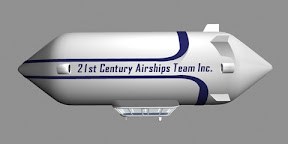
Now 21st Century Airships is working on a new Airship for tourism and sightseeing activities. On their website you can see some great pictures of the gondola which will accommodate up to 19 passengers. Of course such a new development needs a prototype. So 21st Century Airships has build a small scale 2 person prototype of the Voyager Airship which has already complete it's first test flights. Here are the recent announcement released by 21st Century Airships:
September 24, 2007
We have just completed the test flights for the scale version of the Voyager Airship. The Voyager Airship is a 19-passenger craft, purpose designed for sightseeing rides. As expected, the airship was extremely maneuverable and is able to perform VTOL (Vertical Take-Off and Landings). Steering and altitude controls are activated with a joystick, making the pilot's workload very light.

August 1,2007
Our latest airship is now ready to take flight. This distinctive looking airship is a two-seater, scaled-down version of our 19-passenger, sightseeing airship. It will act as a test platform for the many systems, with new and advanced standards, that we are incorporating into our airships.

Although this elongated-shaped airship has stabilizing fins, there are no moving surfaces such as rudders and elevators. Steering and altitude controls are affected by directed thrust from the engines, a system developed and patented by 21st Century Airships Inc. The main advantage of this new system is that it allows the airship to be highly manoeuverable at any speed from 0 to full. This airship has no elevator wheel or rudder pedals. Instead it is simply controlled with a joy-stick.

Test flights are scheduled to begin mid August 2007 near Newmarket, Ontario, Canada. After the initial test flights are completed, the airship will be used for demonstrations, as well as for collecting data for the ongoing Type Certification of our 19-passenger, sightseeing airship.
We quoted the two announcements here since we do not know how long they will stay up on the Website of 21st Century Airships. But make sure to check out the original website for more pictures of the prototype.
The Winnipeg Free Press article we talked about yesterday also mentions that 21st Century Airships is planning on flying the prototype to Winnipeg this coming fall. You can be sure we will be reporting about it when it happens.

Sunday, September 16, 2007

Airships to the Arctic - extended early bird registration

Have you booked your tickets to the Airship to the Arctic Symposium already? No? Well now you have a second chance to get the early bird rate and save 100$ US. The early bird registration has been extended to September 30th 2007 so hurry and get your ticket to the Airships to the Arctic Symposium.
Links:

Monday, September 10, 2007

4th Airships to the Arctic Symposium - October 2007

It's time once again for the Airships to the Arctic Symposium organized by Barry Prentice and his non-profit airship research institute ISO Polar. Airships to the Arctic is a conference aimed at bringing airships especially cargo airships to Canada's north, to assure supply and transport to the northern communities and mining sites. The conference is held every two years in Winnipeg, Manitoba, Canada. This years conference is from October 29th to October 31st 2007. Registration starts now, and you can get an early bird discount if you register before September 15th. You can go to the Airship to the Arctic website and Register online. Since this is the 4th Symposium of that kind. You might be interested in the previous conference proceedings which are available from ISO Polar:
Airships to the Arctic I: Applications For Northern Transportation
October 22nd to 24th, 2002
Edited by: Dr. Barry E. Prentice and Shelley Turriff
Download (PDF Document, Size: 3.00 MB)
Airships to the Arctic II: Moving Beyond The Roads
October 21st to 23rd, 2003
Edited by: Dr. Barry E. Prentice, Jill Winograd, Al Phillips, Bobbi Harrison
Download (PDF Document, Size: 3.62 MB)
Airships to the Arctic III: Sustainable Northern Transportation
May 31st to June 2nd, 2005
Edited by: Dr. Barry E. Prentice, Sharon Cohen, Douglas B. Duncan
Download (PDF Document, Size: 4.45 MB)
Also Available in the Publications Section of ISO Polar are a couple of Studies:
And last but not least take a look at the List of Speakers as well as the Agenda on the Airships to the Arctic Website and read the official invitation that you download via slideshare.com.
Unfortunately I can not attend this conference to report from it first hand, so I hope to be able to get some feedback from Barry Prentice and other attendees about what is going on. If you are attending and want to become our front row reporter for the conference please email us at airshipworld at gmail dot com.