Showing posts with label airship. Show all posts

Monday, April 20, 2009

"prospective concepts" transitions into "iii solutions" - files patent for "hot air airship"

It's sometimes strange how connections emerge when you research for a new article. Today I was looking through recently filed patents in regards to lighter than air and I stumbled over the following patent (WO/2009/046554) HOT AIR AIRSHIP flipping through it and reading the patent (in German Language) I wanted to see if I could find out more about this idea, see if there was already more information available on the web, so I did a quick search for the company mentioned in the patent iii solutions, the website is all flash so I can not link to a specific page. If you look into Current Projects you are greeted by a familiar sight, the Flying Stingray built by prospective concepts that we had featured in our Article called "Airships are just like fish in the sky". We will come back to prospective concepts in a minute but first I want to make the connection to the patent, in the current projects is an item called Hot-airships a click on it reveals a picture that looks very similar to the one found in the patent, it's the picture we also feature in this post. So why is iii solutions using the prospective concepts Stingray, well because it's the follow on company. On the prospective concepts website you can read:

In the aeronautical projects segment, tasks are to be undertaken in future which call for a different corporate structure with a stronger focus on project-specific issues. The decision was therefore taken to set up a new company to handle these projects under the sole management of Andreas Reinhard: iii-solutions GmbH.
Another connection that emerged during the research is the connection of prospective concepts to the pneumatics company Festo which I talked about yesterday, but I assure you that this really pure coincidence and wasn't planned. Festo and prospective concepts have worked together in project focusing on “Use of air” and “Movement in the air”.

I am including the patent below, which wont be of much use if you are not able to read German. Since there is currently no official English translation, I prepared these links to the auto translated Description and Claims. What do you think of the patent and the claims? Post your feed back in the comments or start a discussion in the forum, I would love to hear from you.
(WO/2009/046554) HOT AIR AIRSHIP

Saturday, August 16, 2008

Historic Airship Pictures (the Shenandoah, the Los Angeles, the Akron and the Macon as well as the Zeppelins and many more

The web is a big place and there are many hidden gems, websites that have been put together that contain a wealth of information but see only a few visitors. This post today was inspired by two pictures that I found online. Jim Ford had linked to them on his Delicious account One of the pictures was the homepage of George Starcher called Georges World he has a small section on Airships and some really nice pictures of the USS Los Angeles.
The second picture that Jim had linked to brought me through the Wikipedia to the Naval Historical Center I had bookmarked the website before but got lost in it's vastness. The best thing to navigate that website is the Search function. With this and a bit of knowledge about the Navy Airships you can get to the pages of the:
But you can also find pictures of the mast ship USS Patoka even with airships nearby or moored to the mast the resolution of all those pictures is not huge but good enough it makes a very interesting browse.

If the big Navy rigids aren't you favorites, how about some German Zeppelins? While continuing my search for great historic airship sites I stumbled accross this page called "Luftschiff Zeppelin" I had never seen this page before but was so much more surprised what a wealth of information and content the site had to offer. It contains information about all historic Zeppelins from LZ1 all the way to LZ131 either by serial number or name. So have a look at the Luftschiff Database you have to select either serial number (Baunummer) or name (Bezeichnung). But the page does not stop at the information it contains lot of pictures of airships (Luftschiffe) hangars and people from the industry (Luftschiffer). It contains a database of people and hangars with additional information. Eventhough the page is in german it's a real hidden gem. And if your German is rusty the auto-translated English page is also available here

But those aren't the only good historic resources with pictures. The Homepage of Ford U.Ross featuring pictures of Navy Blimps is a great page. Also a wealth of information can be found at Pilot und Luftschiff unfortunately also a German page but you can find information about Airships check out a lot of galleries find out about different airship types and much more. For the English translation follow this link. There are many more interesting historical websites for example DJ's Zeppelin Page or the Navy Lakehurst Historical Society that contain more historical images and information.

We have shown you only a few of those great websites that you should bookmark because they are gems and not easy to be found. We save everything we find and write about in our delicious account currently 520 bookmarks to pages, pictures, videos and other airship related resources on the web. You can take a look at all our bookmarks by going to delicious. Do you know some hidden gems? A site that you think is a fantastic airship related website that we should mention but maybe haven't yet? Is there a link that we have not in our bookmarks? Let us and everyone else know by posting your favorite airship website in the comments section.

Tuesday, June 24, 2008

Great Zeppelin NT Video of the two brothers

Here is another great Video of the Zeppelin NT#4 and it's older brother the Zeppelin NT#3. Enjoy!

Tuesday, June 17, 2008

The Kite-Glider-Airship

After last nights post about Stephane Roussons Zeppy Airship I had a thought stuck in my head for a long time and I just have to write about it. This is not a news item just a quick thought and a request for feedback. Especially if something similar has been tried before.

So what am I talking about I am talking about an aircraft that unites three different characteristics into one new design that is extremely fuel efficient. The aircraft that I have in my mind unites the features of a kite a glider and an airship.

The airship allows the aircraft to be big but at the same time light, it flies(hovers) without needing any propulsion. The kite can lift up with almost no effort with the wind and can act as a strong sail pulling the aircraft with the wind. The glider can glide downwards over a long distance even into the wind.

Is it possible to build something like that? Can a non propelled aircraft even fly against the wind and achieve any real ground speed or is propulsion needed?

Monday, June 9, 2008

The Slipstreamer

I just received this rather unusual airship design from Darin Selby asking me to put it on the blog so that others could critique it. So please do so, go to Darins website and check out the airship design. Then come back to the Blog and leave you comments or write in the Forum. In the meanwhile we are trying to get more information from Darin about the design.

Also please subscribe to the Blog if you haven't yet, if you subscribe you will get our premium treatment and we will deliver each and every new story directly to your feed reader or email in box, which ever you prefer and the best of all that it's free.

Thursday, April 24, 2008

Festo AirJelly - the flying jellyfish - now more information in English

On Tuesday we reported about the amazing AirJelly the jellyfish that gracefully flies through the air. Unfortunately there wasn't much information in English available. But that has changed now. We found the press release by Festo which you can access here or read the piece about the AirJelly right here and the fulyl release on Scribd. You can also go directly to Festo and get high resolution press pictures of the AirJelly here. Also check out the Video of the AirJelly on YouTube.
Air is the element of the AirJelly. Rather than swimming through water like the AquaJelly, it glides through the air with the aid of its central electric drive and an intelligent, adaptive mechanical system. The remote-controlled AirJelly is kept in the air by its helium-filled ballonet.

The AirJelly’s only energy source are two lithium-ion-polymer batteries, to which the central electric drive is attached. This transmits its power to a bevel gear and then to eight spur gears, which drive the eight tentacles of the jellyfish via their respective cranks. The structure of each tentacle is based on the Fin Ray Effect®. Using a peristaltic movement to drive a balloon was previously unknown in the history of aviation. The AirJelly is the first indoor flying object to use such a peristaltic propulsion system. The jellyfish glides gently through the air thanks to this new drive concept based on the reaction thrust principle.

The AirJelly steers through three-dimensional environments by shifting its weight. Its two servo motors are located at the “North pole” of the jellyfish and controlled proportionally. If the pendulum moves in one direction, the AirJelly’s centre of gravity shifts in this direction – the AirJelly is thus able to swim in any spatial direction. The propulsive force of the drive can be varied by moving the Fin Ray® tentacles more quickly or slowly.

Festo demonstrates with this exhibit that a central electric drive – combined with an intelligent mechanical system – can offer fascinating possibilities for “lighter-than-air” aviation. Festo aims to delight its customers with innovative, fascinating and intelligent solutions in both automation and didactics. It therefore offers a wide range of electric, pneumatic and hybrid drive systems, together with the respective sensors and control possibilities.
If you like Airshipworld and what to get more great news about Airships and everything that is Lighter-Than-Air then subscribe for free to our Feed with a feed reader or let us deliver Airshipworld right into your email inbox by subscribing via email. You can also participate in our Forums or subscribe to the Mailinglist. Join Airshipworld and exchange your thoughts with other airship enthusiasts.

Tuesday, April 22, 2008

Scott Westerfeld rides the Zeppelin NT airship

Scott Westerfeld a bestselling author of science fiction and young adult literature is currently researching for his new trilogy called Leviathan. In a interview with teenreads.com he gave a short description what Leviathan will be about:
It's a new trilogy called Leviathan, which is set in an alternate 1914, at the beginning of the Great War (what we call World War I). It features living airships, walking mechanical war machines, and loads of romance. Plus, it's going to be heavily illustrated by a brilliant artist I've found, almost halfway to graphic novel.
If you want to write about airships you must have experienced them, that's why he is currently on a research tour in Europe and visited Friedrichshafen a few days ago. Of course he took a ride in the Zeppelin NT and describes his experiences in a series of great to read Blog posts.
In his first post called Z-Day he takes us around Friedrichshafen and the omnipresent Zeppelins you see on every corner. His second post appropriately called Z-Day 2 invites us to follow Scott along on his trip, featuring pictures from the Hangar, the landing of the Zeppelin, some videos, aerial shots, pictures form inside the zeppelin and even a picture of the cockpit. It's a great read for every airship fan. And the second post was not the last one. Check out Scott Westerfelds Blog where he will post the third part of his report soon. Also check out his Website scottwesterfeld.com to find out more about him and his books. I am looking forward to the Leviathan trilogy it will be one more series of books that will inspire young readers to learn more about airships.

Sunday, April 13, 2008

The Airship One Project from Poland

No we aren't talking about this AirshipOne we are talking about Airship One (notice the space) it's a Polish airship project from the Wrocław University in Poland. This is a short summary what the project is about:
AirShip One is a construction project of blimp with wireless piloting, that can transfer image from air in real time. Academic Aerial Club has made this project with thought about relating public events in big halls. Purpose of project is accustoming of new technical thought to life, introduction of innovative solutions and exploring of knowledge acquired on Wroclaw University of Technology in practice. Three scientific groups work over project AKL - Aerial Academic Club, DaVinci - Aerial Scientific Group, SP6PWT – Academic Club of Radio Control System also TV STYK - Student Television. AirShip One project has been made in order to cope with claims of media in range advanced relating 'on live' performances. AirShip One is an universal platform which will be capable to take up any optional equipment wanted for realization of intentional purpose. Due to big lateral surface, it can be taken advantage as flying advertising. Appliance construction without skeleton make transport easier and allows to move it in indoors by standard-sized entrances. Bearing capacity of ballast module unit totals 2 -kg. Weight without helium 10 -kg. length - 4; diameter - 2,2m; capacity – coverage 10m3 - 1000.
In our previous Video posts, here and here, we already featured the airship but here are the links to the YouTube videos again:
We got a whitepaper on the project from the main coordinator Princo, unfortunately it is in Polish, we will try to get an English translation but for now you can skim over the Polish version it contains some schematic drawings of the airship and formulas that can be understood even without knowing Polish.
Read this doc on Scribd: KNS- AirShip One
Sterowiec RC, AirShip One, video-sterowiec, sterowiec transmisyjny, obraz Przemysław TOMKÓW Politechnika Wrocławska Wybrzeże Wyspiańskiego 27 50-370 Wrocław Akademicki Klub Lotniczy opiekun naukowy Janusz Gogała AIRSHIP ONE – VIDEO-STEROWIEC RC AirShip One to projekt budowy sterowca pilotowanego bezprzewodowo, mogącego przekazywać obraz z powietrza na ziemię w czasie rzeczywistym. Akademicki Klub Lotniczy stworzył ten projekt z myślą o relacjonowaniu wydarzeń publicznych odbywających się w dużych pomieszczeniach zamkniętych. Celem projektu jest wdrożenie nowych myśli technicznych w życie, wprowadzenie innowacyjnych rozwiązań oraz wykorzystanie wiedzy nabytej na Politechnice Wrocławskiej w praktyce. Nad projektem pracują dwa koła naukowe: AKL - Akademicki Klub Lotniczy oraz Studencki Klub Krótkofalowców – Eter. W projekt włączyła się również TV Styk – Telewizja Studencka. AirShip One stworzono, aby sprostać wymaganiom mediów w zakresie zaawansowanego relacjonowania imprez „on live”. AirShip One to uniwersalna platforma mogąca wynieść dowolną aparaturę potrzebną do realizacji zamierzonego celu. Dzięki dużej powierzchni bocznej, może on być wykorzystywany jako latająca reklama. Zastosowanie konstrukcji bezszkieletowej ułatwia transport oraz pozwala na wprowadzenie sterowca przez wejścia standardowych rozmiarów. Nośność kasetowego modułu balastowego wynosi 3kg. waga bez helu wynosi 10kg. Długość – 4,35m; średnica- 2,2m; objętość – 10m3 zasięg - 1000m. 1.AirShip One – Video-sterowiec RC 1.KONSTRUKCJA Konstrukcja sterowca opiera się o zastosowanie najnowszych dostępnych materiałów. Kryteria, jakimi się kierowaliśmy to bezpieczeństwo, ergonomia, żywotność. Dzięki konstrukcji bezszkieletowej sterowiec będzie łatwy w transporcie i znacznie prostszy w przygotowaniu do lotu. Chcąc podnieść bezawaryjność zdecydowaliśmy o maksymalnym uproszczeniu systemu napędowego oraz systemu sterowania, który zapewnia 7 kanałowa aparatura. Ergonomiczne rozwiązanie kasetowego modułu balastowego znacznie upraszcza montaż oraz ułatwia eksploatację 1.1.PLATFORMA NOŚNA Nośność zapewnia powłoka z tworzywa poliuretanowego wypełniona helem balonowym. Tworzywa poliuretanowe otrzymane na bazie poliestrów liniowych są odporne na oleje, smary, wodę, benzynę i rozcieńczone kwasy i ługi. Hel jest gazem zupełnie bezpiecznym (gaz niepalny) i obojętnym dla środowiska naturalnego. Aby sterowiec wyniósł kamerę z modułem nadawczym ważącą 1,5kg oraz gondolę z silnikami i układem sterowania musi mieć odpowiednią objętość. Z równania Clapeyrona obliczyliśmy nośność 1m3 helu.[1] Sterowiec będzie pracował w obiektach zamkniętych, dlatego przyjęliśmy iż ciśnienie otoczenia wynosi 100kPa. Wysokość lotu ograniczona jest wysokością hali dla uproszczenia założyliśmy, iż wynosi ona 50m. Dla tak małej różnicy wysokości przyrost ciśnienia oraz temperatury możemy pominąć. Masa 1m3 powietrza atmosferycznego wynosi: pV = mRT m p= pV R pT (1) mp=nMp Rp= 8314,7 = 287,12 28,96 (2)  (1) (2) mp = Masa 1m3 czystego helu wynosi: pV = mRT 101325 ⋅ 1 = 1,383kg 287,12 ⋅ 298 mh = pV Rh T (1) mh=nMh Rh= 8314,7 = 2068,3 4,02 (2)  (1) (2) mh = 101325 ⋅ 1 = 0,165kg 2068,3 ⋅ 298 Mp – masa molowa powietrza 28.96g/mol Mh – masa molowa helu 4g/mol mp – masa powietrza mh – masa helu Rp - stała gazowa dla powietrza Rh – stała gazowa dla helu MR – uniwersalna stała gazowa 8315 P - ciśnienie 101,325 kPa V- objętość 1m3 J kg ⋅ K Nośność 1m3 czystego helu wynosi: mp- mh=1,38-0,17=1,21kg W rzeczywistości nośność 1m3 helu wynosi ok. 1kg. Dzieje się tak dlatego, że do napełniania sterowca używalmy helu balonowego o czystości 92-95% Całkowitej masa konstrukcji: Masa powłoki (3,7kg) + masa gondoli (1,2kg)+ masa kamery (0,4kg) + masa akumulatorów(0,7kg) +moduł operacyjny(3kg)+balast wyważający(0,5kg) = 9,5kg Wymiary powłoki: Aby wynieść ciężar 9,5kg potrzebujemy powłokę o objętości: 9,5m 3 na hel 4.0 + 0,5m3 wynikające z konieczności pozostawienia rezerwy na rozszerzalność cieplną helu. Zastosowany zawór bezpieczeństwa chroni korpus przed nadmiernym ciśnieniem gazu. Objętość powłoki powinna wynosić ok. 10m3. Założenia te spełnia elipsa obrotowa o średnicy D=4,35m d=2,2m. 2. Wymiary powłoki 1.2.NAPĘD ORAZ STREROWANIE Napęd stanowią trzy silniki. Dwa klasy SPEED 400 o ciągu 350g każdy odpowiedzialne za ruch; przódtył, góra-dół umieszczone na ruchomych pylonach z włókien węglowych sterowanych mikro serwomechanizmem. Trzeci silnik klasy SPEED 260 umieszczony w dolnym stateczniku pionowym stanowi część fenestronu i odpowiedzialny jest za obracanie sterowca prawo-lewo. Odbiornik oraz pakiet akumulatorów znajdować się będzie w gondoli. 1.3. PRZESYŁANIE OBRAZU Zestaw nadawczo odbiorczy stanowi nadajnik z wbudowaną anteną umożliwia bezprzewodową transmisję sygnału video i fonii w paśmie 5,8Ghz oraz odbiornik umożliwiający odbiór 4 kanałów w sekwencji z regulowanym czasem. Oba elementy zamknięte są w hermetycznej obudowie oraz zasilane są napięciem 12V. Dla zapewnienia ciągłości transmisji wizyjnej wykorzystywane są dwie baterie. Jedna zamontowana w zestawie będzie umożliwiała nieustanną transmisję przez co najmniej 6 godzin, natomiast druga będzie jej zamiennikiem. Ładowanie odbywać się będzie w stacji dokującej w celu umożliwienia jak najprostszej obsługi urządzenia. 2.WYKONANIE Nad budową sterowca pracują 2 koła naukowe Politechniki Wrocławskiej. o o Akademicki Klub Lotniczy – Międzywydziałowe Koło Naukowe Akademicki Klub Krótkofalarski - Eter AKL odpowiedzialny jest za budowę platformy latającej oraz wyposażenie jej w system napędowy oraz system sterowania. Prace prowadzone są w 6-cio osobowym zespole. SP6PWT odpowiada za budowę modułu przesyłu obrazu. Poszczególne etapy powstawiania sterowca: Etap rozpoznawczy – gromadzone są informacje na temat sterowców systemów przechwytu obrazu oraz przesyłu danych. Prowadzone jest badanie rynku w celu rozpoznania podaży oraz popytu na świadczenie usługi video-transmisji z powietrza. Etap konstrukcyjny – określane są kryteria konstrukcyjne, ustalane są pożądane charakterystyki sprzętowe. Następnie wyliczana jest masa podzespołów oraz żądana nośność sterowca. Z równania Clapeyrona otrzymujemy lotność 1m3 helu na podstawie czego dobierane są parametry gabarytowe powłoki. Obliczane są osiągi poszczególnych systemów. Etap ten kończy się utworzeniem listy podzespołów potrzebnych do budowy platformy latającej oraz modułu nadawczego. Etap montażowy – budowa gondoli, powłoki oraz modułu przesyłu obrazu. Prace montażowe prowadzone są w pracowni modelarskiej Młodzieżowego Domu Kultury, z którym zostało podpisane porozumienie na potrzeby realizacji projektu. Oblatywanie sterowca – próby w locie. W pierwszej fazie lot odbywa się bez modułu przesyłu obrazu, który zastępowany jest dodatkowym balastem. Sprawdzana jest sterowność oraz stateczność konstrukcji. Wyznaczane są charakterystyki graniczne tj. prędkość maksymalna, udźwig, zasięg, czas obrotu, czas pracy silników. W drugiej fazie testów sprawdzana jest funkcjonalność modułu video-transmisyjnego. 3.ZASTOSOWANIE Sterowiec będzie wykorzystywany do transmitowania obrazu na imprezach odbywających się w obiektach zamkniętych. Zastosowanie sterowca można rozszerzyć o zrzut ulotek lub pomiar poziomu hałasu. Elementy ruchome lepiej skupiają uwagę odbiorców niż ekspozycje statyczne. Na powierzchni bocznej nadrukowany zostanie baner z logo Politechniki Wrocławskiej, dzięki czemu sterowiec będzie również wykorzystywany w celach promocyjnych uczelni. 4.AirShip One w Auli bud. A1 Politechniki Wrocławskiej - symulacja Wersja rozwojowa przeznaczona będzie do użytku zewnętrznego, a jej zadaniem będzie pomiar poziomu hałasu oraz stworzenie akustycznej mapy miasta Wrocławia. LITERATURA [1] KALINOWSKI E, „Termodynamika Techniczna”, Wrocław, Politechnika Wrocławska, 1979, 14-18 TYTUŁ PRACY W JĘZYKU ANGIELSKIM AirShip One is a construction project of blimp with wireless piloting, that can transfer image from air in real time. Academic Aerial Club has made this project with thought about relating public events in big halls. Purpose of project is accustoming of new technical thought to life, introduction of innovative solutions and exploring of knowledge acquired on Wroclaw University of Technology in practice. Three scientific groups work over project AKL - Aerial Academic Club, DaVinci - Aerial Scientific Group, SP6PWT – Academic Club of Radio Control System also TV STYK - Student Television. AirShip One project has been made in order to cope with claims of media in range advanced relating 'on live' performances. AirShip One is an universal platform which will be capable to take up any optional equipment wanted for realization of intentional purpose. Due to big lateral surface, it can be taken advantage as flying advertising. Appliance construction without skeleton make transport easier and allows to move it in indoors by standard-sized entrances. Bearing capacity of ballast module unit totals 2 -kg. Weight without helium 10 -kg. length - 4; diameter - 2,2m; capacity – coverage 10m3 - 1000.
Do you know about any other airship projects on universities all over the world, tell us about them. Send us an email or present your project directly in our forum which can be used as a mailinglist too, you just have to sign up here. Also please subscribe to our feed either via RSS or you can even get the Blog delivered to you via Email. That way you always have the latest news as soon as we posted them.

Saturday, March 22, 2008

Newest Zeppelin NT picture

Accompanying the latest press release of Zeppelin was a really nice shot of the Zeppelin NT with it's current T-City branding. Enjoy.


To read the press release please click here.

Wednesday, March 12, 2008

AirShipOne - a new Airship Concept

Coming fresh from our Mailinglist we present a new hybrid airship concept developed by Gosha Galitsky as a graduation project in Industrial Design. Click on the image to get to a small picture gallery of the Airship. Also check out this great video that he uploaded to YouTube showing the rendering of the Airship from all sides:
Please continue to stuff like this on the mailinglist or if you do not want to share it yourself in the forums just send it to our main email address airshipworld at gmail dot com and we will make sure to put it in the pipeline to be published. It makes me happy to see the Airshipworld Mailinglist slowly gaining momentum as more people subscribe. Speaking of subscribing please consider also subscribing to the Blog if you haven't yet or tell your friends that they should subscribe. We really want to reach even more people and need your word of mouth to introduce others to our site. We are currently growing at a relatively steady pace which makes me really happy. So please continue to spread the word, it really helps. Subscribing is completely free and will always stay free. Remember that there are two ways to subscribe one is via Email the other one through the RSS feed. Which ever you prefer there shouldn't be any substantial differences except that the feed is probably a bit faster and might have additional features not possible to implement through email.

Sunday, February 3, 2008

The Massaud Airship - more pictures

End of last year we reported about the Massaud - Manned Cloud Hotel if you haven't read our article check back and read it here it also contains a video of the airship. De zeen a design magazine posted a nice article about the airship with a lot more background info on the airship. If the website seems familiar to you, they also published the Strato Cruiser airship concept by Tino Schaedler which we have reported on in November 2007. Check out the de zeen article Manned Cloud by Jean-Marie Massaud here.

Sunday, January 13, 2008

The Snow Bird a record breaking Airship

Copyright by the The Naval Airship Association http://www.naval-airships.org/Today we want to look at a very special airship that made history. The Navy Blimp ZPG-2, No 141561 called the Snow Bird. That went out to challenge the long distance record that was once set by the Graf Zeppelin on it's non-stop flight from Friedrichshafen, Germany to Tokyo, Japan. The two places where the Zeppelin is flying again today. Silver Donald Cameron brought the famous blimp back into our awareness with his column "Another way to fly: blimps" in the Chronicle Herald. The Snow Bird flew from South Weymouth, Mass to Europe, Africa and back across the Atlantic to Key West, Florida marking it the the longest unrefuelled flight ever made by an airship both in distance and time covering 9448 miles (15205 km) in 11 days. So when did that happen one might ask, it happened over 50 years ago and ever since no airship has ever come even remotely close to this record.

To learn more about the flight of the Snow Bird you might want to check out a few more great resources. The Naval Historical Center released a publication called Kite Balloons to Airships...the Navy's Lighter-than-Air Experience outlining the 75 years of history in LTA (Lighter-Than-Air) at the Navy. Chapter "XVI. LTA Records Set in the 1950s"(PDF) outlines the story on the Snowbird in great detail with many pictures. But the whole publication is worth a read. It's a free PDF download.

The Naval Airship Association also had a great article with pictures in their official newsletter The Noon Balloon(PDF) around page 18. Click here to get the Noon Balloon Number 73.

These where the Specifications of the ZPG-2 also called N Class Blimp :
General characteristics
  • Crew: 21
  • Length: 343 ft 0 in (104.57 m)
  • Diameter: 76 ft 0 in (23.17 m)
  • Height: 107 ft 0 in (32.62 m)
  • Volume: 1,011,000 ft³ (23,648 m³)
  • Powerplant: 2 × Wright R-1300-2 radials,, 800 hp (600 kW) each
Performance
  • Maximum speed: 80 mph (128 km/h)
  • Endurance: over 200 hours
How much would it cost to build and operate such a ship today? Would it not be a lot cheaper than 50years ago, wouldn't an airship build with new composite materials perform much better than this 50 years old ship? There is a future for airships, if it was possible to build something like that 50 years ago it's an easy task to build it today. Just take the old design, replace the envelope material with a better one and the engines, too and start from there. A proven airworthy design which could be optimized in future iterations.

So I can only agree to Silver Donald Cameron that airships have a great future ahead. They can provide alternative ways of travel with less fuel consumption than any modern air plane. Sure they are slower but there are lot's of applications where time is not so much an issue. Check out Mr Camerons Blogs Sailing Away from Winter and Silver Donald on Sunday for more columns and bits by him.

If you like this article and our Blog and are not already subscribed, why don't you subscribe, it's FREE. You can subscribe via email, this way articles get send to you directly into your email inbox. Or you subscribe to the RSS feed and use a feedreader to read the blog. But don't forget to take a look at the website, too. Often there are videos or slideshows that do not get delivered in the feed. Also you can find additional links and other stuff on the website which makes it worth a visit.

Saturday, December 29, 2007

Massaud - Manned Cloud Hotel

In November we featured a post about the Stratocruiser and that designers discover airships in this article we also mentioned a site by the designer Jean-Marie Massaud his website features the picture of a great white whale like airship. Now we have kept our eyes open and here is what we found out. It seems to be a project that is not really new. Even though it seems to get attention just in the last few months as it makes it's way through the Blogosphere. The first mentions of this project seem to be in French websites as early as January 2007. One mention is from Liberation.fr (English translation here) and Cote Masion.fr (English translation here) also containing pictures.
A little later in in February 2007 there was a post at 365questions.org which contains the most pictures of the Massaud Manned Cloud which are known to me.
We also found a video on a site that was written in Spanish and has a copyright of 2006 (English translated version here). We uploaded the video to YouTube so that you watch is easily.

As Mentioned earlier in this posts there was quite some coverage about the airship in the last few weeks. It is supposed to be a hotel for eco tourism, able to fly 280km/h and provide 60 rooms for passengers enjoying it's 3 day cruise around the world and as many project state it could be realized as soon as next year.
Considering no airship ever flew that fast it's an ambitious project. According to Modern-Airships the fastest Airship to date was the Macon with about 140 km/h this ship would have to fly twice as fast. Also having 60 rooms on 500 square meters seems like a big step, considering the Hindenburg had about that size of space. Today the largest Airship the Zeppelin NT can carry 12 passengers maximum. So this is another visionary project that we will keep looking into. But till today an airship that can match the Hindenburg, Graf Zeppelin, Akron or Macon still has to be built.
So here is the rest of the Coverage about the Massaud Manned Cloud Airship.
As always our friends at Aerocrat where a good source. check out their post about the Massaud Airship here (English page here)
But also Bornrich.org did their homework well in their Post called "Manned Cloud by Massaud Studio – The flying eco-hotel!" they linked to a some great sources:
One last source also seems to be design-italia with their post "Maned Cloud, Jean-Marie Massaud" (English translation here). We are sure that there is more but we are also wondering how much of this is actually feasible . Right now it seems to be a dream of a designer without much of an engineering background but we love to be wrong on that. If you have more information pictures, numbers, videos anything that might be of interest post a comment or send us an email.

Wednesday, November 28, 2007

The Varialift Airship - a progress update

The Varialift Airship is a new concept for an Airship with a variable lift system, developed and invented by Alan Handley. The variable lift, will make ground handling of this airship a lot easier. We first reported about Varialift back in April 2007 with the Varialift Website announcement and a look at his Varialift patent application today we get the chance to give you a little update as to what has been going on. Mr Handley was so kind and shared this press release with us.
Varialift Airships

The development of the varialift principle has taken a new step forward in recent weeks with the start of construction of two varialift units for proof of concept and test purposes.

The units would form part of a number of units running the length of the airship that will have variable lift capability plus load trimming for the aircraft.

The announcement was made at the Fourth International Symposium “Making it Happen” in Winnipeg Canada on October 31st 2007 during a presentation by Alan Handley CEO of Varialift Airships

The presentation illustrated how the units work and how by using them heavy lift up to 1000 tonnes is possible for cargo carrying over long and short haul flights.

This is the last part of a five year development program of the concept this has included not only the formulation of the aircraft and mathematical modelling but also the IP protection by international Patent Applications

The airship will be constructed entirely of aluminum and the picture below shows the very first section being manufactured.

Further information on the website www.varialift.com
Mr Handley also shared two pictures with us showing "the first top section being tested for self support (A total of 10 will be required)." Enjoy and click on the images to get a bigger version.


Tuesday, November 20, 2007

Total Pole Airship - in pictures and media

We first reported about the Total Pole Airship Expedition way back in April 2007. Back then details were sparse and we promised to keep an eye on the project. Well the wait is over. Here are our updates. After many months the Russian AU-30 (54 m long, 13,5 m diameter, 5,000 m3) built by RosAeroSystems has been completed. Check out this Flickr slideshow by Dominique Pipet


If you can not see the slideshow please go directly to Flickr and visit Dominique Pipet's photos of the Airship. But that's not the only bit we have for you. A few updates to the Total Pole Airship Website where totally (no pun intended) missed by our radar. So check them out, the first article from August 20th 2007 is entitled "Construction speeds up" the second one posted September 21, 2007 titled "Our airship arrives" next one from September 28, 2007 has the title "The balloon is filled" and the last one from October 16, 2007 with the title "The official christening of the Total Pole Airship at Marseille airport"
Also on a side note Jim Smith from the Airship-list pointed to this article "Monaco Prince to Go to North Pole on Russian Airship" which states that Prince Albert II may join the expedition next year. Jim Smith also found another good article here "TOTAL POLE AIRSHIP : Mesurer la banquise" (click here for the English translation). Searching through the site there was also another article with great pictures of the filling of the Airship check it out here Naissance d'un dirigeable (click here for the English version). And at the very end of that article was a link to a Video showing the filling of the airship in moving pictures. Check it out here. That's it for now, there is more material about the Total Pole Airship Project out there and we will pick up the topic again for sure as things are progressing. Make sure to check out all those links they contain many many nice pictures most of them that I haven't seen before. If you have any more websites, articles, links, videos or pictures that you would like to share, post a link in the comments or send us an email.

Monday, November 19, 2007

Strato Cruiser - the designers discover Airships

On October 8th the website dezeen a design magazine published a post called "Strato Cruiser airship concept by Tino Schaedler and Michael J Brown" featuring a futuristic design for a cruise airship. You can check out the original Pictures of the Stratocruiser if you go to Tino Schaedlerswebsite at http://www.tinoschaedler.com then click on "Artwork" -> "Projects in Detail" -> "Architectural/ Exhibition Design" and there you find the link to the Stratocruiser pictures. Tino Schaedler who was born in Germany is an Art Director in the movie industry and just recently was also "artdirector for digital sets" in the Movie The Golden Compass check out the Trailer here, is it just a coincidence that this movie featured an airship? And what about Stardust there was an Airship in there too. And do you remember the Blimp a final year project by Carl Hagerling from Sweden. Read our post about his design project of a swivelling blimp-envelope being vertical when landing and horizontal in flight.
And just recently Johannes Eißing from the great RC Airship Regatta Yahoo Group pointed out a new site that features an Airship http://www.massaud.com/ not much is known about that site at this moment but we will do our best to find out more. If you have any information for us that that you would like to share with our readers please don't hesitate to write a comment or send us an email, your feedback is always welcome and helps us to deliver more of what you want and less of what you do not want to read.
Also I would like to apologize for keeping the updates at such a low pace. There are things happening behind the scenes that I can not yet talk about but keep checking back or subscribe to the Blog and get automatic updates.

Wednesday, October 31, 2007

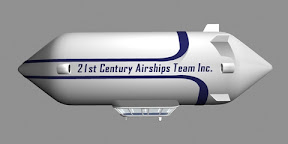
The Voyager Airship by 21st Century Airships

21st Century Airships a Canadian Airship Development Company, is currently working on a new airship. Up until now 21st Century Airships has been famous for their spherical Airships. They also successfully licenced their technology to the US company Cyber Defense Systems. To see pictures and even a video of their original airship you can also check out a post on the Blog crashworks.
Now 21st Century Airships is working on a new Airship for tourism and sightseeing activities. On their website you can see some great pictures of the gondola which will accommodate up to 19 passengers. Of course such a new development needs a prototype. So 21st Century Airships has build a small scale 2 person prototype of the Voyager Airship which has already complete it's first test flights. Here are the recent announcement released by 21st Century Airships:
September 24, 2007
We have just completed the test flights for the scale version of the Voyager Airship. The Voyager Airship is a 19-passenger craft, purpose designed for sightseeing rides. As expected, the airship was extremely maneuverable and is able to perform VTOL (Vertical Take-Off and Landings). Steering and altitude controls are activated with a joystick, making the pilot's workload very light.

August 1,2007
Our latest airship is now ready to take flight. This distinctive looking airship is a two-seater, scaled-down version of our 19-passenger, sightseeing airship. It will act as a test platform for the many systems, with new and advanced standards, that we are incorporating into our airships.

Although this elongated-shaped airship has stabilizing fins, there are no moving surfaces such as rudders and elevators. Steering and altitude controls are affected by directed thrust from the engines, a system developed and patented by 21st Century Airships Inc. The main advantage of this new system is that it allows the airship to be highly manoeuverable at any speed from 0 to full. This airship has no elevator wheel or rudder pedals. Instead it is simply controlled with a joy-stick.

Test flights are scheduled to begin mid August 2007 near Newmarket, Ontario, Canada. After the initial test flights are completed, the airship will be used for demonstrations, as well as for collecting data for the ongoing Type Certification of our 19-passenger, sightseeing airship.
We quoted the two announcements here since we do not know how long they will stay up on the Website of 21st Century Airships. But make sure to check out the original website for more pictures of the prototype.
The Winnipeg Free Press article we talked about yesterday also mentions that 21st Century Airships is planning on flying the prototype to Winnipeg this coming fall. You can be sure we will be reporting about it when it happens.

Saturday, September 8, 2007

The airship of 1670

Who would have thought that the first design for a literal air ship was from 1670. But it's true. A Jesuit by the name of Francesco Lana de Terzi published a book called "Prodomo ovvero saggio di alcune invenzioni nuove premesso all'arte maestra" in which he described a small ship with mast and a sail on it, that could fly by having four copper spheres containing a vacuum. According to wikipedia:
The spheres would be made of very thin copper foil, and each sphere would have a diameter of 7.5 meters (about 24.5 feet). Terzi had calculated that the weight of a sphere would be 180 kilograms (396 lbs). He also calculated that a sphere containing air would weigh 290 kilograms (638 lbs). The copper spheres would be pumped to vacuum conditions, and thus being lighter than the surrounding air, would provide enough lift for 6 passengers to ride along in the airship.
Yes a vacuum airship, answering the question of what is lighter than hydrogen, because only nothing is lighter than H. Lanas design has never been build, in fact it was proven to be physically impossible. But is it really impossible to have a vacuum airship? I just recently found a new Russian Website of a 3D Designer named Michael Levin on his page, he has many really impressive renderings but one stands out for me, the rendering of a vacuum airship since the page is in Russian read the autotranslated version but what counts are the impressive pictures like this one:


So the question remains can it really not be built? Nano-Materials and Material Science is leapfrogging in the last few years aren't there chances that there is already a material that has the right characteristics. Wait! Do we even know the right characteristics? I researched a few Websites for example:
Unfortunately none of these websites provides any scientific calculations, either proving unfeasible or proving that it is possible. And in my eyes until no one has proven that there can not exist a material light and strong enough to be able to achieve vacuum buoyancy. I would say it's still worth a try. But I don't want to start a long discussion if it is possible or not. What is needed is a collection of formulas, joint together in a program so that it can be simply calculated. It's a very interdisciplinary problem, involving physics and material science and engineering. None of the disciplines can solve the problem alone. But as I said the first step would be to collect the right formulas needed.

Please check out the Airshipworld Wiki Page on Vacuum Bouyancy with the first calculations. And contribute to the page if you know formulas, can correct errors or want to add thoughts.

Friday, August 24, 2007

Airship Parade Video - part 4

Today we bring you the 4th and last video (for now) of the Airship Parade. We have some shorter Clips that we will edit and upload later but the main event is covered now. Following our photo and video coverage we will now dive into the teams, their companies, the advantages of hot air airships but also the disadvantages. We will give an overview of costs, and give information on how you can get one, either for lease or to own.


Also watch parts one to three:
Airship Parade Video - part 1
Airship Parade Video - part 2
Airship Parade Video - part 3

If you liked the videos, and would like to publish them on your website, please contact us, we will assist you in doing so. You can share them completely free but we ask you to provide proper credit to Airshipworld.

Tuesday, August 21, 2007

Airship Parade Video - part 3

The airship parade continues, now the competition starts the airships compete in the first airship bowling ever captured on video, at least we think so :-) The hot air airship perform very risky maneuvers and touch the ground a couple of times.

Video Part 3


Also watch parts one and two:

Airship Parade Video - part 1
Airship Parade Video - part 2