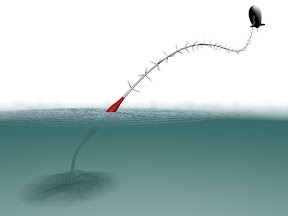
In January of this year the web was once more flooded by a fantastically designed airship concept called aeolus. The design was part of the intermediate examination (Vordiplom) of Christopher Ottersbach for an Industrial Design Degree. What's interesting is that the concept was presented in April 2008 to the public at the Hochschule für Bildende Künste Braunschweig, Germany but somehow it got into the web and a bunch of Eco Blogs picked it up, here just two of them.
Much is not known about the thoughts that went in to the project but one thing is clear the word "Design" plays a very big role in it. It has to be understood that the concept is mainly looking good and conveys a vision. It should not be seen as an engineering prototype. Commenters on the Colorado Airship-List pointed out that because of it's shape the airship would get minimal to no aerodynamic lift in contrary to the headline of one of the blogs above. Another lister pointed out:
[The] Large hull surface area means weight, drag and superheat troubles. This design would be [...] sensitive to lateral gusts and vertical wind gradients. [...] the turning characteristics would be challenging, if not a nightmare. Plus the aerostatic pressure would be relatively high compared to conventional airships.
So even though the project might look fantastic building something that would actually fly is a different story. To learn more about the project you can check the following two websites:
One thing that the airship community should take away from this is that new airship concepts also need the right presentation and working together with industrial designers might help improving the image of airships and maybe even the looks. I will try to get a hold of Christopher Ottersbach to get more background information and hopefully more pictures. Also I would love to hear from him how he designed the Airships, which tools he used and how the airship industry can profit form his work.If you happen to know Christopher please send him here maybe he can post a comment or join a discussion on the Forums.
While it is easy to write about the Zeppelin, the Goodyear Blimps or the Metlife Blimps. There are other posts that are a bit more challenging because they touch a controversial announcement or project. Today we want to take a look at Turtle Airships the company of Darrell Campbell. His concept and design was first made prominent as the Millenium Airship SkyFreighter which used Campbells deisgns as inspiration. He continued to develop his concept and now promotes his own airship called the Turtle Airship described as a
Rigid SHELLED Lighter-than-Air, >200mph, AMPHIBIOUS, all weather passenger airships. SOLAR POWERED with Bio-fuel backup power
Unfortunately there is today no airship that can even tick one of those boxes there is no rigid shelled airship, none that flies faster than 200mph, non that is amphibious or can fly in all weather. No human carrying airship that is solar powered or uses bio-fuel. Tree Hugger has written about Turtle Airships in 2007 but published a quite critical article just recently which you can read here. This article came in response to a press release that Turtle Airships issued. Read on for the full text:
Giant Flying Turtles to Revolutionize Global Aviation with Solar Power
A new way to fly! Turtle Airships company announces the beginning of construction iof a demonstration model of a new form for lighter-than-air airships. The airships are not blimps. They are solar powered and will reach speeds of 200 mph.
Valencia, Spain (PRWEB) July 2, 2008 -- Turtle Airships company will change the world aviation industry with 200 mph solar powered airships. Constructed with rigid shelled hulls of aluminum and carbon fiber, the airships look like giant turtles. These "turtle" airships are not blimps or zeppelins. The airships are being designed in Spain and the U.S.
Construction has started on a first prototype and the first flight and testing is scheduled to be done in Singapore this year. Turtle Airships will make a demonstration around-the-world flight of the new solar powered airship in 2009.
The airships' hulls are covered with solar cells which power the airships during daylight hours. For flying at night or cloudy weather, the airships use bio-diesel fueled jet engines as a back-up system. The airships cruise at speeds which are comparable to some airplanes.
The airships take off and land straight up and down like a helicopter and are amphibious. They land directly onto the water and take on water ballast for stability like a boat. The airships can land in harbors, rivers, mountain lakes, or the middle of the ocean.
The airships will also land on any empty field or at airports, and use built in systems to anchor to the surface without ground crew assistance. Turtle airships do not need huge hangers and can fly in any weather.
"Almost everyone immediately thinks of blimps or the Hindenburg," says company president, Darrell Campbell. "The Turtle airship is far more advanced in technology and capabilities."
Although there are less than fifty blimps or zeppelins in the world now, Turtle Airships expects to field hundreds of its' solar powered airships. Turtle Airships plans to invest over $200 million in airship manufacturing plants and airship operations by 2012; with an expected (IPO) public offering to raise over $3 billion scheduled for 2015. To reach these goals the company will work with local and national Economic Development agencies throughout the world to train workers and develop solar powered airship programs. Turtle Airships will also enter into joint ventures and is seeking venture capital and private investments which are directed toward alternative fuels and solar energy.
The company will concentrate on building airships meant for the travel market, with secondary emphasis given to military applications. The company had been originally considered for a U.S. Department of Defense airship program called "WALRUS", which was to create giant airships for military transport. Turtle Airships is designing airships for security surveillance and interdiction of pirates in the waters off of Somalia, Indonesia, and Nigeria.
Turtle Airships will also use "flying hospitals" to deliver worldwide humanitarian aid. Carrying doctors, foods, emergency equipment and other supplies, airships can avoid delays and complex delivery systems by flying to disaster areas and landing directly where help is needed. The airships will be made available to the United Nations, International Red Cross, Red Crescent, and other aid organizations.
"Turtle Airships is the only company in the world that is focused on creating a new aviation industry based on solar powered flight," says Campbell. "We can save over $100 billion each year on fuel costs alone, another several hundred billion dollars in airport construction, and eliminate a major source of carbon emissions. Airships are a trillion dollar industry, still in its' infancy, that will grow for decades."
Darrell Campbell is the designer of the "turtle" airship, and president of the twenty-seven year old company.
The claims that can be read in this press release are very bold, especially since an airship of that size will have to be certified by numerous aviation authorities and that it took Zeppelin almost 8 years to get the Zeppelin NT certified. So a round the world flight in 2009 seems very unlikely to me. We wish Darrell and his Company all the luck in the world and we hope to see pictures and videos of the prototype soon, because 2009 is approaching fast. if you want to read more about Turtle Airships it's best to take a look at the Turtle Airships Blog were Darrell actively promotes his designs and outline why traditional blimps are not the best solution. He also writes two other blogs MILITARY- AIRSHIPS (no blimps) and solar flight! which are also promoting his ideas.
So what do you think. Does it sound like a hoax or a scam to you or do you think the idea is brilliant? Do you maybe even know more, have additional pictures or inside information? Please share them with us in the comments, by sending us an email or by talking to other fellow readers in the Forum
I just received this rather unusual airship design from Darin Selby asking me to put it on the blog so that others could critique it. So please do so, go to Darins website and check out the airship design. Then come back to the Blog and leave you comments or write in the Forum. In the meanwhile we are trying to get more information from Darin about the design.
Also please subscribe to the Blog if you haven't yet, if you subscribe you will get our premium treatment and we will deliver each and every new story directly to your feed reader or email in box, which ever you prefer and the best of all that it's free.
There have been many ideas on how to use airships, may it be as mobile camera platforms either remote controlled or manned, for sightseeing flights, as high altitude platform, as aerial cruise ships or business yachts or even as surveillance tool. Using Airships in disaster relief has not been discussed for a while but the recent disasters in China and Burma which almost coincidentally happened right around the time when the 2008 ACIDO Rocket Show and competition announced their winners changed this. The ACIDO Rocket 2008 is a graduation show and competition where students of the three schools of Industrial Design in Ontario Canada present their works. One of the Categories was Natrual Disaster and Andrew Leinonen from the Humber College with his concept called "Solarial – Mobile Power Generation for Disaster Relief" won best in category. This is how he describes his project:
Solarial is an unmanned airship that provides mobile support infrastructure for disaster relief and remote communities, generating renewable energy and supplying communications links where they are needed most. Utilizing a skin coated in thin film photovoltaics, and a reversible drive propeller/wind turbine, it delivers clean energy via tether cable. Housing a suite of telecommunications equipment, Solarial also acts as a relay station for radio and cellular telephone signals, aiding the coordination of relief operations.
While that's the mission brief for the project, the rationale behind it was to produce an airship at a modest scale, fulfilling a present need, to act as a transitionary element towards a more sustainable aerospace industry based around airships.
You can check out the presentation on the ACIDO Website which features some very nice pictures and illustrations on how the concept is supposed to work. Even more information can be found on Andrews Blog pulltheskydown.com where he talks about the Solarial Concept in more detail. What's most interesting about the Solarial concept is that it combines multiple ideas into one package. Having a quickly deployed airship that turns into a tethered aerostat that can provide energy as well as a telecommunications relay for on site communications gives new flexibility to disaster relief. The Solarial is also supposed to fly autonomously to it's destination giving humanitarian help organization a chance to call for a Solarial which will then provide the necessary base infrastructure on a disaster site. In the coming years we will hopefully see more airships being used in disaster relief especially if more people demand them, because they can be a solution to today's problems in building up infrastructure at disaster sites.
But building up infrastructure is not only a topic that is interesting for humanitarian missions the military is also very interested in using airships for their missions. Using small airships for surveillance or larger ones as communication platforms. While writing this article I remembered a project by BOSCH Aerospace called REAP (Rapid Elevated Aerostat Platform) which is a project where an Aerostat is being transported deflated by jeep to the site, and then inflated and deployed in a matter of minutes. Check out this YouTube video of the REAP System:
While the REAP Platform is mostly used for surveillance the way it is deployed is quite remarkable seeing the aerostat inflating completely by itself without any human interaction.
Another project that came to my mind is the Selsam SUPERTURBINE a project to create highly efficient wind power generators. One of the concepts also includes a blimp that is tethered and has Superturbines attached to the tether. Something that could be incorporated with the Solarial? Or what about the Magenn Windtrubine also a lighter-than-air tethered power generator. The Magenn project just recently made the first trial test with their system, we reported on it here.
The possibilities seem to be endless when it comes to envisioning the usages of airships for green power generation. We are looking forward to the future hoping to the these projects become reality.
If you know of other projects that are using airships in new and exciting ways let us know. Also I want to thank Duncan Rice, Paul Bloch and Andrew Leinonen for their input which helped me write this article.
Coming fresh from our Mailinglist we present a new hybrid airship concept developed by Gosha Galitsky as a graduation project in Industrial Design. Click on the image to get to a small picture gallery of the Airship. Also check out this great video that he uploaded to YouTube showing the rendering of the Airship from all sides:
Please continue to stuff like this on the mailinglist or if you do not want to share it yourself in the forums just send it to our main email address airshipworld at gmail dot com and we will make sure to put it in the pipeline to be published. It makes me happy to see the Airshipworld Mailinglist slowly gaining momentum as more people subscribe. Speaking of subscribing please consider also subscribing to the Blog if you haven't yet or tell your friends that they should subscribe. We really want to reach even more people and need your word of mouth to introduce others to our site. We are currently growing at a relatively steady pace which makes me really happy. So please continue to spread the word, it really helps. Subscribing is completely free and will always stay free. Remember that there are two ways to subscribe one is via Email the other one through the RSS feed. Which ever you prefer there shouldn't be any substantial differences except that the feed is probably a bit faster and might have additional features not possible to implement through email.
The Varialift Airship is a new concept for an Airship with a variable lift system, developed and invented by Alan Handley. The variable lift, will make ground handling of this airship a lot easier. We first reported about Varialift back in April 2007 with the Varialift Website announcement and a look at his Varialift patent application today we get the chance to give you a little update as to what has been going on. Mr Handley was so kind and shared this press release with us.
Varialift Airships
The development of the varialift principle has taken a new step forward in recent weeks with the start of construction of two varialift units for proof of concept and test purposes.
The units would form part of a number of units running the length of the airship that will have variable lift capability plus load trimming for the aircraft.
The announcement was made at the Fourth International Symposium “Making it Happen” in Winnipeg Canada on October 31st 2007 during a presentation by Alan Handley CEO of Varialift Airships
The presentation illustrated how the units work and how by using them heavy lift up to 1000 tonnes is possible for cargo carrying over long and short haul flights.
This is the last part of a five year development program of the concept this has included not only the formulation of the aircraft and mathematical modelling but also the IP protection by international Patent Applications
The airship will be constructed entirely of aluminum and the picture below shows the very first section being manufactured.
Mr Handley also shared two pictures with us showing "the first top section being tested for self support (A total of 10 will be required)." Enjoy and click on the images to get a bigger version.
On October 8th the website dezeen a design magazine published a post called "Strato Cruiser airship concept by Tino Schaedler and Michael J Brown" featuring a futuristic design for a cruise airship. You can check out the original Pictures of the Stratocruiser if you go to Tino Schaedlerswebsite at http://www.tinoschaedler.com then click on "Artwork" -> "Projects in Detail" -> "Architectural/ Exhibition Design" and there you find the link to the Stratocruiser pictures. Tino Schaedler who was born in Germany is an Art Director in the movie industry and just recently was also "artdirector for digital sets" in the Movie The Golden Compass check out the Trailer here, is it just a coincidence that this movie featured an airship? And what about Stardust there was an Airship in there too. And do you remember the Blimp a final year project by Carl Hagerling from Sweden. Read our post about his design project of a swivelling blimp-envelope being vertical when landing and horizontal in flight. And just recently Johannes Eißing from the great RC Airship Regatta Yahoo Group pointed out a new site that features an Airship http://www.massaud.com/ not much is known about that site at this moment but we will do our best to find out more. If you have any information for us that that you would like to share with our readers please don't hesitate to write a comment or send us an email, your feedback is always welcome and helps us to deliver more of what you want and less of what you do not want to read. Also I would like to apologize for keeping the updates at such a low pace. There are things happening behind the scenes that I can not yet talk about but keep checking back or subscribe to the Blog and get automatic updates.
Keith Kothmann recently provided information about his new lenticular Airship called The Kothmann. He filed a patent for it and is currently working on building his first prototype. The United States Patent 6648272 can be read at freepatentsonline.com or you can download the PDF directly here if you don't want to read through the patent, read on since we are going to give you a little overview. The first and most noteable fact about the Kothmann Concept is the cost, compared to other airships today the project cost is estimated with less than 500,000 $ for the prototype. All of the airships components are current off the shelf technology according to it's constructor to keep the cost low and the speed of development high. The Flying Saucer shaped airship will be controlled by a variable lift technology that compresses the helium used for aero static lift when wanting to land, which reduces the neccesary ground crew. The same variable lift system can be used to trim the ship inflight to changing conditions. Due to it's design, the Airship can be stacked together with others, for heavy lift operations. To achive this the Kothmann Airship is equipped with a central cable that links the airships, and all airships would be contributing their maximum lift to the cable, on which the cargo would be transported. These are just some of the many interesting ideas behind this new Concept, even more detail can be obtained in a paper that Keith provided. It's a detailed description of the concept and a bit easier to read than the patent. Get it here: The Kothmann - Paper [PDF] Please leave your comments, what do you think about it, would you like to get more information about it, do you have questions? We are going to bring you more information as it becomes available.
We have reported about Carl Hagerling's Blimp project in a previous post, now we have some more stuff to look at. First of a Video showing how the supposed moving of the gondola should work. Check out this YouTube video
Also there are some more pictures of the design. One must of course understand that this is a design study, not a technical project. We will tyr to get some more background information on it. But this is an innovative oncept mich might be worth a closer look.
Tonight we are announcing the launch of a new website, for a new airship company called Varialift, it's a rigid-airship concept, for a freight airship, that doesn't need a large ground crew to handle cause it has, as the name suggests variable lift. On the ground it is heavier than air and with it's variable buoyancy units becomes lighter-than-air to take off. It's a great concept and I'm looking forward to seeing it. Check out the new Website http://www.varialift.com/. Of course we will keep you updated, on the going ons with this project. Please also give Mister A. Handley a feedback on his website.