If you have been reading the Blog for a while you will know that Festo is not a stranger to this Blog. They have been making the news pretty regularly every year with their Bionic Learning Networks flying animals which they develop as eye catchers for the Hannover Messe each year. After the flying manta ray called Air_ray in 2007 and the flying jellyfish called AirJelly in 2008 this year it's penguins and you guessed it they are appropriately named AirPenguin. The Air_ray did make it onto YouTube a while after it was presented at the Hannover Messe, the AirJelly was uploaded by Airshipworld to YouTube directly when it was published on Festos website, the result was that the AirJelly got a tremendous publicity all over the web with over 380.000 views of it's video. This year Festo decided to start their own YouTube Channel called FestoHQ and they added all the Videos of the things that they will be presenting at the Hanover Messe 2009 which starts tomorrow April 20th 2009. So here you go watch the graceful AirPenguins fly, and also watch the second video with some more of Festos projects that they will be presenting, the second Video also contains an explanation of the AirPenguins. Unfortunately Festo disabled the embedding of the videos which is a shame. If you aren't into the videos to much, just below we have added the whitepaper that you can get from Festo which explains the Airpenguins technology, its an interesting read especially for those building small remote conrtolled airships themself.
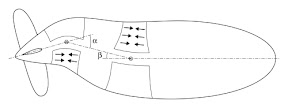
AirPenguin A group of autonomously flying penguins Info Flying through the sea of air with collective behaviour AirPenguin – technology-bearers for adaptive flapping-wing mechanisms The AirPenguin is an autonomously flying object that comes close to its natural archetype in terms of agility and manoeuvrability. It comprises a helium-filled ballonett, which has a capacity of approx. 1 cubic metre and thus generates approx. 1 kg of buoyant force; at each end of the ballonett is a pyramid-shaped flexible structure of four carbon fibre rods, which are connected at joints by a series of rings spaced approx. 10 cm apart. The rings together with the carbon fibre rods yield a 3D Fin Ray ® structure that can be freely moved in any spatial direction. The Fin Ray ® structure was derived from the anatomy of a fish’s fin and extended here for the first time to applications in three-dimensional space. Each pair of spatially opposed carbon fibre rods is connected via bowden wires and a double pulley, and can be extended and retracted in contrary motion by means of an actuator. This gives rise to rotation free of play both at the tip of the AirPenguin’s nose and at the end of its tail. By superimposing two perpendicular planes of rotation, any desired spatial orientation can be realised. A strut to which the two wings are attached passes through the helium-filled ballonett. This new type of wing design can produce either forward or reverse thrust. Each wing is controlled by two actuators: a flapping actuator for the up-and-down movement of the wings, and a further unit that displaces the wing strut to alter the pressure point of the wings. There is also a central rotational actuator for the two flapping wings that directs their thrust upwards or downwards, thus making the AirPenguins rise or descend. All three actuators are proportionally controlled. This makes for continuously variable control of the flapping frequency, forward and reverse motion, and ascent and descent. Penguins are fascinating creatures which have lost their ability to fly in the course of their phylogenetic development as marine birds. With the AirPenguins, the engineers have created artificial penguins and taught them “autonomous flight in the sea of air”. The knowledge acquired from this research project of Festo’s Bionic Learning Network is to be put to use for future requirements in the automation of production processes. The entire wing complex comprises a strut with flat flexible wings of extruded polyurethane foam. The wing strut, which is supported at the pivot point of the torso, can be moved either towards the front or rear edge of the wing. Displacing the strut towards the front, for example, causes the wing’s pressure point to migrate forwards. The pressure of the airstream bends the cross-section of the wing in such a way as to produce a profile that generates forward thrust. If the wing strut is moved towards the rear edge of the wing, the pressure point is likewise moved to the rear, and the AirPenguin flies backwards. With this design a self-regulating, wing pressure-controlled, passively twisting adaptive wing has been realised for the first time. 2 Rear section with 3D Fin Ray ® structure AirPenguin – autonomous self-regulating systems with collective behaviour The AirPenguins are also equipped with complex navigation and communication facilities that allow them to explore their “sea of air” on their own initiative, either autonomously or in accordance with fixed rules. The underlying project: A group of three autonomously flying penguins hovers freely through a defined air space that is monitored by invisible ultrasound “transmitting stations”. The penguins can move freely within this space; a microcontroller gives them free will in order to explore it. The microcontroller also controls a total of nine digital actuators for the wings and for the head and tail sections. By means of XBee, based on ZigBee, large volumes of data can be transmitted between the penguins and the transmitting stations by 2.4-GHz band radio. The penguins recognise each other on the basis of their distances to the transmitting stations. The rapid, precise control allows the AirPenguins to fly in a group without colliding, while also mastering height control and positional stability. As an alternative, they can act synchronously as a group. A comprehensive central surveillance system provides security in case of sensor failure and reports low energy supply. Whenever necessary, it prompts the penguins to return to the charging station. Technology-bearers for the automation technology of tomorrow If the 3D Fin Ray ® structure of the head and tail sections is transferred to the requirements of automation technology, it can be used for instance in a flexible tripod with a very large scope of operation in comparison with conventional tripods. Fitted with electric drive mechanisms, the BionicTripod from Festo for example makes for precise, rapid movements, just like the AirPenguin. Autonomous, versatile, adaptive self-regulating processes will acquire increasing significance in future for automation in production. The animal kingdom can provide insights here which, when implemented by resourceful engineers, lead to astounding new applications. The ongoing development of sensor and control technology is thus also being promoted along the road to decentralised, autonomously self-controlling and self-organising systems thanks to inspiration from nature. The transfer to automation technology is also to be found by analogy in regulating technology from Festo, for example in the new VPPM and VPWP proportional-pressure regulators for servo-pneumatics. 3 Technical data Overall length: Max. torso diameter: Helium volume: Wing span: Weight: Control of wings, head and tail segments: Materials Buoyancy body: Head and tail segments: Wings: Wing strut: Accumulator battery for wing drive and torso orientation: Receiver sensors: 3.70 m 0.88 m 0.980 cbm 2.48 m 1.0 kg 9 digital actuators, range 180° aluminium-metallised foil, 22 g/qm 3D Fin Ray Effect ® structure of carbon-fibre rods extruded polyurethane foam carbon-fibre rod Project partners Project initiator: Dr. Wilfried Stoll, Chairman of the Supervisory Board, Festo AG Project manager: Dipl.-Ing. (FH) Markus Fischer, Corporate Design, Festo AG & Co. KG AirPenguin concept and realisation: Rainer and Günther Mugrauer, Clemens Gebert Effekt-Technik GmbH, Schlaitdorf, Germany Autonomous control concept and realisation: Dipl.-Ing. Agalya Nagarathinam, Dipl.-Ing. Kristof Jebens Ingenieurbüro Jebens & Nagarathinam GbR, Gärtringen, Germany Photos: Walter Fogel, Angelbachtal, Germany Graphic design: Atelier Frank, Berlin, Germany Li-Po battery, 2000 mAh, 4.2 V 32-bit microcontroller @ 50 MHz MCU 2x LM3S811 64 kbyte flash, 8 kbyte RAM SCP 1000 pressure sensor ultrasound receiver capsules Altitude measurement: Distance measurement: Measurement of rotation rate about vertical axis: Lisy 300-AL gyroscope Directional and positional sensors: positionally compensated 3-axis compass with accelerometer Temperature measurement: temperature sensor 2.4 GHz radio transmission: based on ZigBee Current and voltage monitoring for Li-Po cell Overvoltage protection: DS2764 Li-Po protector Charging controller for Li-Po cell: Max1555 charging controller Accumulator battery: Li-Po battery, 2000 mAh, 4.2 V Base stations/ transmitting stations: Altitude measurement: Distance measurement: Temperature measurement: 2.4 GHz radio transmission: Current and voltage monitoring for Li-Po cell Overvoltage protection: Charging controller for Li-Po cell: Energy reserve for approx. 50 h continuous operation: Brands: 32-bit microcontroller @ 50 MHz MCU LM3S811 64 kbyte flash, 8 kbyte RAM SCP 1000 pressure sensor ultrasound transmitters temperature sensor based on ZigBee Festo AG & Co. KG Corporate Design Plieninger Straße 50 73760 Ostfildern Germany www.festo.com/bionic Phone +49 711/347- 38 80 Fax +49 711/347- 38 99 fish@ de.festo.com DS2764 Li-Po protector Max1555 charging controller Li-Po battery, 2000 mAh, 4.2 V Fin Ray Effect ® is a brand of EvoLogics GmbH, Berlin, Germany 54709/EN
I don't want to leave you completely without videos so here the Air_ray and the AirJelly videos from 2007 and 2008.
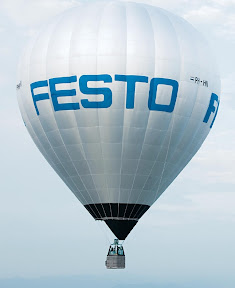
A Hot Air Balloon looses a lot of its lift by the heat that radiates out of the envelope. This heat loss has to be counter acted by reheating the air inside the envelope. So how could a hot air balloon made more energy efficient and the reheating reduced? By insulating the envelope so that it doesn't loose so much heat and that is exactly what Festo has done. The company that is known for its AirJelly and AirRay lighter than air projects continues to innovate. Festo has build a hot air balloon that uses up to 70% less energy than a comparable traditional hot air balloon. This is achieved with a new material that sits on the inside of the balloon envelope. This aerofabríx® insulation not only reduces heat loss it also extends the life of the envelope by reducing the heat of the outer envelope layer. Check out the whitepapers below for the full detail, more information and additional pictures. I could imagine that this new envelope material would be of great use for Dan Nachbars Personal Blimp as well as the Gefa Flug hot air airships.
Insulated hot - air balloon A hot - air balloon with fuel consumption reduced by half Innovative insulation sets standards in energy efficiency for balloons Volume - specific buoyancy (kg / m²) 0.40 +50 % 0.30 -50 % with 3.5 mm insulation without insulation 0.20 0.10 0.00 200 surface - specific heat output (W / m²) 300 400 500 600 700 800 Flock insulator Results of measurements on the model balloon (volume: 30 m3) Conveying five persons in a hot-air balloon for one hour consumes around the same amount of fuel as an economical passenger car during a drive from Berlin to Barcelona. Thanks to an innovative ultra - light membrane flock insulating material, the fuel consumption of a balloon can be reduced by more than 50 %, or its carrying capacity can be correspondingly increased for the same consumption rate. Insulated hot - air balloon, which was manufactured for Festo, is the world’s first balloon to include this new insulating material, which allows the number of fuel cylinders to be reduced and additional passengers to be transported. At the same time, the thermal load on the balloon material is reduced and its service life thereby extended. In the development project HeiDAS (hot-steam aerostat) by Festo, steam was used instead of hot air to fill the balloon. Steam has twice the load-bearing capacity of air; however, it necessitates insulation to prevent condensation from forming on the interior of the balloon envelope. For this purpose, flock insulation is bonded to a light but sensitive carrier foil that was first produced on commission from Festo in 2003. The membrane flock insulating material was further developed and applied to the insulated steam balloon. A new ultralight metallised base fabric transforms the foil into an insulating material suitable for everyday use in balloons. The innovative membrane flock insulating material provides the layer of air required for insulation by means of vertically oriented raised fibres on the base membrane. This membrane with its spacing elements is known as the spacing layer. The gap is closed by a covering layer. The insulting effect is determined by the width of this space, the flock pattern and the surface characteristics of the spacing and covering layers. The outer layer of the balloon envelope itself provides the insulation. The membrane flock insulating material is extremely light, highly reflective, mildly heat - reflective, temperature - resistant, compressible, readily adaptable to individual requirements and easily optimised by means of adjusting the spacing gap and the number of layers. High compressibility is a fundamental requirement, since balloons are packed and transported after a flight. Simulations and measurements carried out with test balloons have provided for initial insulation optimization and savings estimates. Subsequent measurements on the test balloons have confirmed that fuel consumption is reduced by half for a given buoyant force, or carrying capacity is considerably increased for a given quantity of fuel. 2 Insulated hot - air balloon in the air The lightweight insulation is situated on the interior of the envelope, where it is protected against the adverse effects of everyday handling; this insulation in turn protects the load bearing envelope against the effects of high temperatures. Higher temperatures than usual are encountered on the inner surface of the insulating material, while the cooler exterior of the envelope hardly radiates any heat. To test this technology in practice, the engineers from UltraMagic and the Technical University of Berlin undertook trials using a first manned and insulated test balloon with a volume of 1.600 m3, under various conditions for a period of six months. This prototype completed about 100 hours of operation, during which it attained consumption savings of more than 70 % and confirmed the material’s durability. With increasing size, the ratio of a balloon’s surface area to its volume decreases. At the same time, the internal pressure on the insulating material increases and reduces the insulating gap between the envelope layers. These effects could impair the function of the insulation. To demonstrate the effectiveness of the aerofabríx® insulation in the new Festo insulated hot - air balloon, a special race was staged: fuel consumption was measured in a direct comparison with an uninsulated balloon of the same volume and with the same load. After 40 minutes of operation, the conventional balloon had used 37.2 kg of Thermographic images without insulation (left, approx. 55° C) and with insulation (right, approx. 40° C) of model balloons with 30 m3 volume and identical load-bearing capacity propane – the contents of several tank cylinders. The insulated hot air balloon, by contrast, had consumed less than 11 kg – in other words 30 % of the fuel required by the conventional balloon; this represents a drastic improvement in energy efficiency. The insulated hot - air balloon shows what innovations are possible in lighter - than - air aviation. Festo manufactures energy - efficient products and advises its customers as to how energy can be put to even more efficient use in automation. With the insulated hot air balloon insulated balloon envelope, it will be possible to make balloon travel 50 % more efficient in future. 3 Technical data Balloontype: Volume: Envelope weight: Passengers: Fabric insulation: Thickness: Specific weight: Thermal conductivity: U value (6 mm): Max. operating temperature: M - 105 3000 m3 158 kg 4–5 aerofabríx® [Iso] 45 | 4.5 6 mm 45 g / m2 0,0265 W / mK 4,5 W / m2K 140° C Project partners Project initiator: Dr. Wilfried Stoll, Chairman of the Supervisory Board, Festo AG Project manager: Dipl. - Ing. (FH) Markus Fischer, Corporate Design Festo AG & Co. KG Envelope concept and manufacture: Josep Maria Lladó Costa, UltraMagic S.A., Igualada, Spain Material development and manufacture: Dr. - Ing. Alexander Bormann, Dipl. - Ing. Stefan Skutnik, Milan Habovcik, German Aerospace Centre (ILR), Technical University of Berlin, Germany Christian Gebhardt, aeroíx, Berlin, Germany Thermographic images and laboratory tests: Ilka Rudolph, Martin Wähmer, Maik Scheel German Aerospace Centre (ILR), Technical University of Berlin, Germany Flock technology consultants: Prof. Chokri Sherif, Birgit Mrozik Institute of Fibre and Apparel Technology (ITB), Technical University of Dresden, Germany Joachim Müller, Engineer’s office for flock technology, Büdingen, Germany Balloon operator for Festo: Rien Jurg Promotions BV, Hengelo, The Netherlands Further support and consultation: Prof. Jürgen Thorbeck, German Aerospace Centre (ILR), Technical University of Berlin Yousif Abdel Gadir, aerarium e.V., Berlin, Germany Photos: Walter Fogel, Angelbachtal, Germany Festo AG & Co. KG Corporate Design Rechbergstraße 3 73770 Denkendorf www.festo.com / ballooning Phone +49 / 7 11 / 347 - 38 80 Fax +49 / 7 11 / 347 - 38 99 fish@de.festo.com Brand designation: aerofabríx® is a brand of Dr. - Ing. Alexander Bormann, Berlin, Germany 53342 EN
Isolierter Heißluft - Ballon Ein Heißluft - Ballon mit halbiertem Brennstoffverbrauch Innovative Isolation setzt Maßstab bei der Energie - Effizienz von Ballonen Volumenspezifischer Auftrieb (kg/m2) 0,40 +50 % 0,30 -50 % mit 3,5 mm Isolation ohne Isolation 0,20 0,10 0,00 200 Oberflächenspezifische Heizleistung (W/m2) 300 400 500 600 700 800 Membran-Flock-Dämmstoff Ergebnisse der Messungen am Modellballon mit 30 m3 Um im Heißluftballon mit fünf Personen eine Stunde in der Luft zu schweben, wird etwa so viel Brennstoff verbrannt, wie ein sparsames Auto für die Fahrt von Berlin nach Barcelona benötigt. Mit Hilfe eines innovativen, ultraleichten Membran - Flock Dämmstoffs kann nun der Verbrauch des Heißluftballons um mehr als 50 % gesenkt bzw. dessen Tragkraft bei gleichem Verbrauch entsprechend gesteigert werden. Der isolierte Heißluft - Ballon, der für Festo gebaut wurde, ist der weltweit erste Ballon, der mit dieser neuen Isolation ausgeliefert wird. Die Isolation ermöglicht die Reduzierung der Anzahl von Brennstoffzylindern und die Mitnahme von zusätzlichen Passagieren. Gleichzeitig reduziert sich die thermische Beanspruchung der tragenden Ballonhülle, was die Lebensdauer der Hülle verlängert. Im Entwicklungs - Projekt HeiDAS (Heißdampfaerostat) von Festo, wurde anstelle von Heißluft im Ballon Wasserdampf verwendet. Dieser besitzt die doppelte Tragkraft, erfordert aber eine Isolation, um die Kondensation des Dampfes im Traggasbehälter zu vermeiden. Dafür wurde 2003 im Auftrag von Festo erstmals die Flockisolation auf leichter, aber empfindlicher Trägerfolie produziert. Der Membran-Flock-Dämmstoff wurde weiterentwickelt und auf den isolierten Heißluft-Ballon übertragen. Ein neues ultraleichtes, metallisiertes Trägergewebe macht nun aus der Folienisolation einen alltagstauglichen Ballondämmstoff. Beim innovativen Membran - Flock - Dämmstoff wird die für die Dämmwirkung erforderliche Luftschicht durch senkrecht auf der Trägermembran stehende, aufgeflockte Fasern gewährleistet. Die Trägermembran mit Abstandshaltern wird Abstandslage genannt. Der Spalt wird durch eine Decklage geschlossen. Der Abstand, das Flockmuster und die Oberflächeneigenschaften von Abstandslage und Decklage definieren die Isolationswirkung. Bei der Ballonisolation stellt die äußere Ballonhülle selbst die Decklage dar. Der Membran - Flock - Dämmstoff ist extrem leicht, hoch reflektierend, gering wärmeabstrahlend, temperaturbeständig, komprimierbar, leicht konfektionierbar und durch Spaltabstand und Lagenanzahl einfach optimierbar. Hohe Komprimierbarkeit ist eine grundlegende Forderung, da Ballone nach dem Flug verpackt und transportiert werden. Simulation und Messungen an Versuchsballonen erlaubten eine Voroptimierung der Isolation und die Abschätzung der Einsparung. Die nachfolgenden Messungen an Versuchsballonen bestätigten eine Halbierung des Verbrauchs bei gleich bleibendem Auftrieb bzw. eine deutliche Steigerung der Tragkraft bei gleichem Verbrauch. 2 Isolierter Heißluft - Ballon in der Luft Die leichte Isolation wird an der Innenseite des Ballons angebracht, womit sie vor den rauen Einwirkungen beim Handling des Ballons geschützt ist und ihrerseits nun die tragende Hülle vor hohen Temperaturen schützt. Dabei treten an der Innenseite der Isolation durchaus höhere Temperaturen als üblich auf, die kühlere Außenseite der Hülle strahlt kaum noch Wärme ab. Um die neue Technologie in der Praxis zu erproben, testeten die Ingenieure von UltraMagic und der Technischen Universität Berlin sechs Monate lang einen ersten bemannten und isolierten 1600 Kubikmeter großen Versuchsballon unter verschiedenen Einsatzbedingungen. Dieser Prototyp absolvierte etwa 100 Flugstunden, erreichte Verbrauchseinsparungen von über 70 % und bestätigt die Haltbarkeit des Materials. Mit zunehmender Größe verringert sich das Verhältnis von Oberfläche zu Volumen der Ballone. Gleichzeitig steigt der Innendruck auf die Isolation und presst den isolierenden Spalt weiter zusammen. Diese Effekte könnten den Vorteil der Isolation schmälern. Um die Wirksamkeit der aerofabríx® Isolation beim neuen isolierten Heißluft - Ballon von Festo zu demonstrieren, fand eine Wettfahrt der besonderen Art statt: parallel zu einem nicht isolierten Ballon mit gleichem Volumen und gleicher Beladung galt es, den Verbrauch im direkten Vergleich zu bestimmen. Nach 40 Minuten Fahrzeit verbrauchte der konventionelle Ballon mit 37,2 kg Propan den Inhalt aus mehreren Tankzylindern. Thermografieaufnahmen ohne Isolierung (links, ca. 55° C) und mit Isolierung (rechts, ca. 40° C) an Modellballonen mit 30 m3 Volumen bei gleicher Tragkraft Der isolierte Heißluft-Ballon begnügte sich hingegen mit weniger als 11 kg und benötigte somit nur 30 % des Brennstoffs im Vergleich zum konventionellen Ballon; eine extreme Verbesserung der Energie-Effizienz. Der isolierte Heißluft - Ballon zeigt, welche Innovationen in der Leichter-als-Luft-Luftfahrt möglich sind. Festo stellt energieeffiziente Produkte her und berät seine Kunden, wie die Energie in der Automation noch effizienter genutzt werden kann. Mit der isolierten Ballonhülle ist es in Zukunft möglich, das Ballonfahren um 50 % effizienter zu betreiben. 3 Technische Daten Ballontyp: Volumen: Hüllengewicht: Passagiere: Stoffisolation: Lagendicke: Flächengewicht: Wärmeleitfähigkeit: U-Wert (6 mm): max. Einsatztemperatur: M - 105 3000 m3 158 kg 4–5 aerofabríx® [Iso] 45 | 4.5 6 mm 45 g / m2 0,0265 W / mK 4,5 W / m2K 140° C Projektbeteiligte Projektinitiator: Dr. Wilfried Stoll, Aufsichtsratsvorsitzender der Festo AG Projektleiter: Dipl. - Ing. (FH) Markus Fischer, Corporate Design Festo AG & Co. KG Hüllenkonzept und Fertigung: Josep Maria Lladó Costa, UltraMagic S.A., Igualada, Spanien Materialentwicklung und Fertigung: Dr. - Ing. Alexander Bormann, Dipl. - Ing. Stefan Skutnik, Milan Habovcik, Institut für Luft - und Raumfahrt, Technische Universität Berlin Christian Gebhardt, aeroíx, Berlin Thermografieaufnahmen und Laborversuche: Ilka Rudolph, Martin Wähmer, Maik Scheel, Institut für Luft - und Raumfahrt, Technische Universität Berlin Flock-Technologieberatung: Prof. Chokri Sherif, Birgit Mrozik, Institut für Textil- und Bekleidungstechnik, Technische Universität Dresden Joachim Müller, Ingenieurbüro für Flocktechnologie, Büdingen Betrieb der Ballone für Festo: Rien Jurg Promotions BV, Hengelo, Niederlande Weitere Unterstützung und Beratung: Prof. Jürgen Thorbeck, Institut für Luft - und Raumfahrt, Technische Universität Berlin Yousif Abdel Gadir, aerarium e.V., Berlin Fotos: Walter Fogel, Angelbachtal Marken: aerofabríx® ist eine Marke von Dr. - Ing. Alexander Bormann, Berlin Festo AG & Co. KG Corporate Design Rechbergstraße 3 73770 Denkendorf www.festo.com / de / ballooning Telefon 07 11 / 347 - 38 80 Telefax 07 11 / 347 - 38 99 fish@de.festo.com 53341 GE
Festo was so kind to send us the English whitepaper on the flying jelly-fish called AirJelly. We had posted the German version of it in our first post which also included the great video of the Air Jelly which has been seen over 40.000 times now. Also check out our second post about where we link to the English press release which contains some great highres pictures of the project.
AirJelly An airborne jellyfish with electric drive unit Info Glides through the air by peristaltic motion A central electric drive unit with crank mechanism Can the jellyfish’s motion through water serve as a propulsion principle for an airborne object? In other words, is it possible to glide through the air as a jellyfish swims through water? These were the considerations that gave rise to the development of AirJelly. The history of aviation has been aware of the analogy between the media of water and air ever since the first gas balloon flights of Jacques Alexandre César Charles, who on 1st December 1783 set off from Paris on the first ever manned gas balloon journey together with Noel Robert. The gondola of the “Charlière” was designed in the form of a ship’s hull. The balloon of the French aviator Jean Pierre François Blanchard, who crossed the English Channel from Dover to Calais together with Dr. John Jeffries on 7 th January 1785, also used a gondola in the form of a ship’s hull. It is therefore all the more surprising that this analogy from a bygone era has not provided inspiration for adapting the propulsion mechanisms of marine creatures for drive units in the aviation sector. In 2005, the Swiss Materials Science & Technology Development (EMPA) in Dübendorf near Zurich presented a concept in which the balloon of an airship was to be covered with electro-active polymer foils. The airship was to float in the sea of air like a fish in water. This airship has since been fitted with elevators and rudders actuated with electro-active polymer foils. Seeking recourse to jellyfish as a source of inspiration for powering gas-filled balloons is an obvious thought; after all, a jellyfish consists of water to 99%. Its weight-to-volume ratio is approximately 1, and the figure is similar for a gas-filled balloon. Jellyfish fossil finds indicate an ability to survive dating back more than 500 million years. Jellyfish have thus repeatedly adapted to various environmental and living conditions and have become veritable survival artists; the diversity of jellyfish species suggests a high degree of adaptability. AirJelly is a remote radio-controlled airborne jellyfish with a central electric drive unit and an intelligent adaptive mechanism. AirJelly consists of a helium-filled ballonett with a diameter of 1.35 meters. This yields a filling volume of 1.3 cubic meters of helium. Since one cubic meter of helium provides buoyancy to lift approximately one kilogram, the total weight of AirJelly, comprising its ballonett and all ancillary components, must amount to no more than 1.3 kilograms. AirJelly houses two lithium-ion polymer accumulator batteries rated at 8 V and 400 mA, which can be completely charged in half an hour and are AirJelly’s sole source of power. A connected central electric drive unit transmits the force to a bevel gear wheel and 2 then to eight spur gears in sequence. These gears power eight shafts, each of which activates a crank; these in turn move the jellyfish’s eight tentacles. Each tentacle is designed as a structure with Fin Ray Effect ® – a construction derived from the functional anatomy of a fish’s fin. The actual structure consists of two alternating tension and pressure flanks movably connected by ribs. If a flank is subjected to pressure, the geometrical structure automatically bends in the direction of the applied force. Together, the tentacles produce a peristaltic forward motion similar to that of their biological model. Controlling AirJelly’s motion in three-dimensional space is effected by weight displacement. For this purpose, a pendulum is set in motion by two actuators in the X and Y directions. The actuators are positioned at the jellyfish’s “north pole” and are proportionally controlled. The pendulum is 55 centimetres long. AirJelly’s centre of mass is displaced in the direction of the pendulum’s motion; the jellyfish then moves in the same direction. By means of this peristaltic forward motion, AirJelly can move in any spatial direction. Propulsion of a ballonett by means of peristaltic motion is as yet unknown in the history of aviation. AirJelly is thus the first indoor flight object with peristaltic drive. Observation of models from nature gave rise to this new propulsion concept for the airborne jellyfish. With this exhibit, Festo is demonstrating that a central electric drive unit in combination with an intelligent mechanism opens up fascinating opportunities in propulsion systems for lighter-than-air flight. Both in automation and in didactics, Festo sets out to generate enthusiasm among its customers with innovative, fascinating and intelligent solutions; it therefore offers a wide range of electric, pneumatic and hybrid drive units, along with the appropriate sensor systems, control and regulating components. 3 Project partners Project initiator: Dr. Wilfried Stoll, Chairman of the Supervisory Board, Festo AG Project team: Rainer and Günther Mugrauer, Effekt-Technik GmbH, Schlaitdorf, Germany Project manager: Markus Fischer, Corporate Design Festo AG & Co. KG Graphic design: Atelier Frank, Berlin, Germany Technical data Diameter: Height: Total weight: Propulsion: Reduction ratio: Power supply: 1.35 m 2.20 m 1.3 kg coreless motor, 3 V 262:1 lithium-ion polymer accumulator batteries; 8 V and 400 mA Festo AG & Co. KG Corporate Design Rechbergstraße 3 73770 Denkendorf Germany www.festo.com/de/bionic Phone +49/7 11/347-38 80 Fax +49/7 11/347-38 99 fish@de.festo.com Photos: Walter Fogel, Angelbachtal, Germany Brand designation: Fin Ray Effect ® is a brand of Evologics GmbH, Berlin, Germany 52938 EN
Please don't forget to subscribe to Airshipworld if you haven't subscribed yet. You can subscribe to our RSS Feed or via Email. Subscribing is free but it helps us to know how big our audience is and to see how many people are interested in airships.
On Tuesday we reported about the amazing AirJelly the jellyfish that gracefully flies through the air. Unfortunately there wasn't much information in English available. But that has changed now. We found the press release by Festo which you can access here or read the piece about the AirJelly right here and the fulyl release on Scribd. You can also go directly to Festo and get high resolution press pictures of the AirJelly here. Also check out the Video of the AirJelly on YouTube.
Air is the element of the AirJelly. Rather than swimming through water like the AquaJelly, it glides through the air with the aid of its central electric drive and an intelligent, adaptive mechanical system. The remote-controlled AirJelly is kept in the air by its helium-filled ballonet.
The AirJelly’s only energy source are two lithium-ion-polymer batteries, to which the central electric drive is attached. This transmits its power to a bevel gear and then to eight spur gears, which drive the eight tentacles of the jellyfish via their respective cranks. The structure of each tentacle is based on the Fin Ray Effect®. Using a peristaltic movement to drive a balloon was previously unknown in the history of aviation. The AirJelly is the first indoor flying object to use such a peristaltic propulsion system. The jellyfish glides gently through the air thanks to this new drive concept based on the reaction thrust principle.
The AirJelly steers through three-dimensional environments by shifting its weight. Its two servo motors are located at the “North pole” of the jellyfish and controlled proportionally. If the pendulum moves in one direction, the AirJelly’s centre of gravity shifts in this direction – the AirJelly is thus able to swim in any spatial direction. The propulsive force of the drive can be varied by moving the Fin Ray® tentacles more quickly or slowly.
Festo demonstrates with this exhibit that a central electric drive – combined with an intelligent mechanical system – can offer fascinating possibilities for “lighter-than-air” aviation. Festo aims to delight its customers with innovative, fascinating and intelligent solutions in both automation and didactics. It therefore offers a wide range of electric, pneumatic and hybrid drive systems, together with the respective sensors and control possibilities.
If you like Airshipworld and what to get more great news about Airships and everything that is Lighter-Than-Air then subscribe for free to our Feed with a feed reader or let us deliver Airshipworld right into your email inbox by subscribing via email. You can also participate in our Forums or subscribe to the Mailinglist. Join Airshipworld and exchange your thoughts with other airship enthusiasts.
Last year Festo surprised everyone with their amazing prototype of the Air_ray a manta ray that swims through the air and the b-IONIC Airfish. We reported on it in a great post which was titled "Airships are just like fish in the sky" Festo is currently at the Hannover Messe 2008 and they brought an just as stunning new project with them. We present the Air Jelly, a jellyfish that swims through the air. Currently the information about the AirJelly is only available in German at the Festo Website but the pictures speak for them self, of course we also provide you with a direct link to the autotranslated Page in English about the AirJelly The Video on the Website of Festo did not work for me so I uploaded it to YouTube just in case you can not see the "Flim" on the Festo website:
There is also a Whitepaper available as PDF which you can also read on Scribd it's also in German, an English version is not yet available to my knowledge:
AirJelly Eine Luftqualle mit elektrischem Antrieb Info Mit peristaltisch erzeugtem Vortrieb durch die Luft Zentraler elektrischer Antrieb mit Kurbelmechanik Gibt es eine Möglichkeit, die Fortbewegungsart der Quallen im Wasser auch in der Luft als Antrieb zu nutzen? Ist es also möglich, mit einer Qualle im Luftmeer zu „schwimmen“, wie dies eine Qualle im Wasser tut? Diese Fragen standen am Anfang der Entwicklungen von AirJelly. Die Geschichte der „Luft-Schiffahrt“ kennt die Analogie zwischen den Medien Wasser und Luft schon seit den ersten Gasballonfahrten durch Jacques Alexandre César Charles, der am 1. Dezember 1783 zusammen mit Noel Robert die erste bemannte Gasballonfahrt von Paris aus durchführte. Die Gondel der „Charlière“ war in der Form eines Schiffsrumpfes ausgebildet. Auch der Ballon des französischen Ballonfahrers Jean Pierre Francois Blanchard der zusammen mit Dr. John Jeffries am 7. Januar 1785 den Ärmelkanal von Dover nach Calais überquerte, nutze eine Gondel in Form eines Schiffsrumpfes. So ist es verwunderlich, dass diese Analogie in der Vergangenheit nicht dazu geführt hat, Antriebe, welche von Meeresbewohnern benutzt werden, auf Antriebe im Bereich der Luftfahrt zu übertragen. Die Eidgenössische Materialprüfungs- und Forschungsanstalt (EMPA) in Dübendorf bei Zürich hat im Jahr 2005 ein Konzept vorgestellt, bei dem die Hülle eines Luftschiffes mit elektroaktiven Polymer-Folien aktuiert werden soll. Das Luftschiff soll im Luftmeer schwimmen, analog zu einem Fisch im Wasser. Mittlerweile hat dieses Luftschiff aktiv durch elektroaktive Polymer-Folien betriebene Höhen- und Seitenruder. Quallen als Inspirationsquelle für neuartige Antriebe bei Gasballonen zu bemühen, ist naheliegend - besteht doch eine Qualle selbst zu 99% aus Wasser. Das Gewichts-/Volumenverhältnis liegt bei den Wasserquallen bei ca. 1:1. Das Gewichts-/Volumenverhältnis bei einem Gasballon liegt ebenfalls bei ca. 1:1 im Vergleich dazu. Fossilienfunde von Quallen deuten auf eine Überlebensfähigkeit seit über 500 Millionen Jahren hin. Die Quallen haben sich damit immer wieder an die unterschiedlichen Umwelt- und Lebensbedingungen angepasst und sind so wahre Überlebenskünstler geworden. Die Diversität der unterschiedlichen Quallenarten deuten auf einen hohen Grad der Anpassungsfähigkeit hin. AirJelly ist eine funkferngesteuerte Luftqualle mit einem zentralen elektrischen Antrieb und einer intelligenten, adaptiven Mechanik. AirJelly besteht aus einem mit Helium gefüllten Ballon mit einem Durchmesser von 1,35 Meter. Hieraus ergibt sich ein Befüllvolumen von 1,3 Kubikmeter Helium. Da ca. 1 cbm Helium ca. 1 Kilogramm Gewicht trägt, darf das Gesamtgewicht von AirJelly mit Hülle und allen Anbauten ca. 1,3 Kilogramm nicht überschreiten. 2 AirJelly enthält zwei Lithium-Ionen-Polymer-Akkus mit 8 Volt und 400 mA. Die Akkus können in 0,5 Stunden vollständig geladen werden und dienen AirJelly als einzige Energieversorgung. Ein daran angeschlossener zentraler elektrischer Antrieb überträgt die Kraft auf ein Kegelrad und anschließend nacheinander auf acht Stirnräder. Diese Stirnräder bewegen acht Wellen, die jeweils eine Kurbel in Gang setzt, welche die acht Tentakel der Qualle bewegen. Jedes Tentakel ist als Struktur mit Fin Ray Effect ® ausgebildet. Der Fin Ray Effect ® ist eine von der funktionellen Anatomie der Fischflosse abgeleitete Konstruktion. Die Struktur selbst besteht aus einer alternierenden Zug- und Druckflanke, die mit Spanten gelenkig verbunden ist. Wenn eine Flanke mit Druck beaufschlagt wird, wölbt sich die geometrische Struktur von selbst entgegen der einwirkenden Kraftrichtung. Zusammen sorgen die Tentakel für einen peristaltischen Vortrieb, ähnlich dem des biologischen Vorbildes. Die Steuerung im dreidimensionalen Raum von AirJelly erfolgt durch Gewichtsverlagerung. Hierzu wird ein Pendel über zwei Servomotoren in X und Y Richtung ausgelenkt. Die Servomotoren sitzen am „Nordpol“ der Qualle und werden proportional gesteuert. Das Pendel hat eine Länge von 0,55 Meter. Bewegt sich das Pendel in eine Richtung, verändert sich der Schwerpunkt von AirJelly in diese Richtung – AirJelly schwimmt nun in diese Richtung des ausgelenkten Pendels. So ist es AirJelly in Kombination mit dem peristaltischen Vortrieb möglich, in jede Raumrichtung zu schwimmen. Ebenfalls kann die Schubkraft des Antriebs durch schnelleres oder langsameres Bewegen der Fin Ray® Tentakel variiert werden. Den Vortrieb eines Ballons durch eine peristaltische Bewegung zu erzeugen, ist bis jetzt in der Luftfahrtgeschichte nicht bekannt. AirJelly ist aus diesem Grund das erste Indoor-Flugobjekt mit peristaltischem Antrieb. Die Auseinandersetzung mit Vorbildern in der Natur hat hier zu einem neuen Antriebskonzept für AirJelly geführt. Festo zeigt mit diesem Exponat, dass ein zentraler elektrischer Antrieb – kombiniert mit einer intelligenten Mechanik – faszinierende Möglichkeiten bei Antrieben in der „Leichter-als-Luft-Fahrt“ bietet. Sowohl in der Automation als auch in der Didactic möchte Festo seine Kunden mit innovativen, faszinierenden und intelligenten Lösungen begeistern. Hierfür hat Festo ein breites Angebot an elektrischen, pneumatischen und hybriden Antrieben sowie der dazugehörigen Sensorik und den Steuerungs- und Regelungsmöglichkeiten. 3 Projektbeteiligte Projektinitiator: Dr. Wilfried Stoll, Aufsichtsratsvorsitzender der Festo AG Projektteam: Rainer und Günther Mugrauer, Effekt-Technik GmbH, Schlaitdorf Projektleiter: Markus Fischer, Corporate Design Festo AG & Co. KG Grafik: Atelier Frank, Berlin Technische Daten Durchmesser: Höhe: Gesamtgewicht: Antrieb: Untersetzung: Energieversorgung: 1,35 Meter 2,20 Meter 1,3 Kilogramm Glockenankermotor, 3 Volt 262 : 1 Lithium-Ionen-Polymer-Akkus mit 8 Volt und 400 mA Festo AG & Co. KG Corporate Design Rechbergstraße 3 73770 Denkendorf Germany www.festo.com/de/bionic Telefon 07 11/347-38 80 Telefax 07 11/347-38 99 fish@de.festo.com Fotos: Walter Fogel, Angelbachtal Marken: Fin Ray Effect ® ist eine Marke der Evologics GmbH, Berlin 52863 GE
Some time ago there has been an Article circulating the web about "Airships that «swim» through the atmosphere" the idea is to use so called electro active polymers to bend and airships body so that it moves like a fish. This Airship is constructed by the Empa a materials science and technology research institution that is part of the ETH Domain. But this is not the only fish in the sky. Prospective Concepts another Company from Switzerland developed the Flying Stingray an ultralight lifting body in the shape of a stingray but still using propellers as propulsion. You can read some more background info at MyAirship.com But wait isn't there more? Of course there is. We proudly present the Festo Air Ray, a manta ray shaped helium filled rc airship that flies by flapping it's wings rather than using a propeller. Watch the stunning video of the Air Ray literally swimming through the air. A really innovative new concept that actually works. You can also check out the animation and a PDF with more detailed information and contact info. But the story about new and revolutionary concepts doesn't stop here. Last but by no means least, the Festo b-IONIC Airfish a remote controlled airship that uses an ion beam propulsion system. Yes you read correct those ion beam drives that are used in space missions are now applied to propulsion systems or aircraft. But besides using this just for propulsion the engineers at Festo also discovered that the effect created could also be used to reduce and even eliminate drag if the whole vessel would be enclosed by a ionized plasma bubble. When one thinks about airships and their huge surface area and the aerodynamic drag they produce this might be a solution that could change how we look at airships. Check out the video of the Airfish and the PDF going into detail and also containing some more pictures. We will continue to look at Festo in the future, since they are an active supporter of the Lighter-Than-Air community, right now also supporting GEFA-Flug in the development of the new 6 seater Hot Airship by donating their Envelope for tests. But more about that in a different post. Do you know of any other revolutionary concepts, and research projects that try to copy nature or just try to go new ways in Airship design? Please send us a link or write a comment we are eager to hear what is currently developed out there. I have to thank Paul Bloch a friend of Airshipworld at openartist.net who send me the links about the Festo Air Ray and the b-IONIC Airfish, he is also involved in the Airship League activities, so expect to hear more from him and the League soon. Additional credits also go to Paul for his comment on the Aeroplume post who inspired the title.
 © Festo