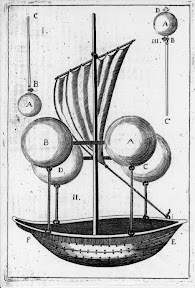
 Who would have thought that the first design for a literal air ship was from 1670. But it's true. A Jesuit by the name of Francesco Lana de Terzi published a book called "Prodomo ovvero saggio di alcune invenzioni nuove premesso all'arte maestra" in which he described a small ship with mast and a sail on it, that could fly by having four copper spheres containing a vacuum. According to wikipedia:
The spheres would be made of very thin copper foil, and each sphere would have a diameter of 7.5 meters (about 24.5 feet). Terzi had calculated that the weight of a sphere would be 180 kilograms (396 lbs). He also calculated that a sphere containing air would weigh 290 kilograms (638 lbs). The copper spheres would be pumped to vacuum conditions, and thus being lighter than the surrounding air, would provide enough lift for 6 passengers to ride along in the airship.Yes a vacuum airship, answering the question of what is lighter than hydrogen, because only nothing is lighter than H. Lanas design has never been build, in fact it was proven to be physically impossible. But is it really impossible to have a vacuum airship? I just recently found a new Russian Website of a 3D Designer named Michael Levin on his page, he has many really impressive renderings but one stands out for me, the rendering of a vacuum airship since the page is in Russian read the autotranslated version but what counts are the impressive pictures like this one:
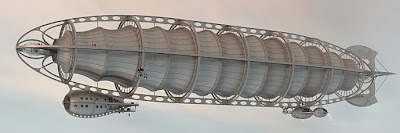
So the question remains can it really not be built? Nano-Materials and Material Science is leapfrogging in the last few years aren't there chances that there is already a material that has the right characteristics. Wait! Do we even know the right characteristics? I researched a few Websites for example:
- Vacuum Dirigibles
- Layered shell vacuum balloons
- Bio-Technical Airship
- The Father of Aeronautics
- Airships reborn
- Would a balloon filled with vacuum instead of helium float?
- The Holy Grail of Airships
- Inflated Shell for Vacuum Balloon
Please check out the Airshipworld Wiki Page on Vacuum Bouyancy with the first calculations. And contribute to the page if you know formulas, can correct errors or want to add thoughts.
